It’s our evening routine, Clover and me.
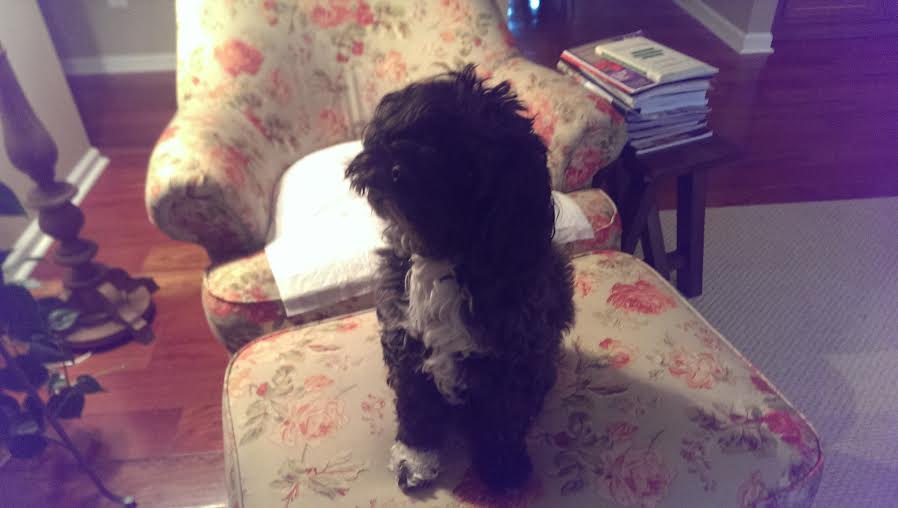
Each night, after I return with the big dogs from our romp down the road, I gently wake my geriatric cockapoo who sleeps nestled in fleece blankets on my red Parisian sofa. She’s black with tuxedo markings and a single white paw. Clover is small and mighty, still the alpha of the pack after all these years.
Her white glove works like a hook, grasping my arm as I lift her. Soon she settles into the crook of my left arm, her body gently shaped like the letter c across my chest. I kiss her right ear and softly tell her she’s perfect, my baby, and the only dog I ever raised.
If she’s alert, she tilts her head to one side to receive the words, smiling with her tail. Most days she rests her warm head against me and lets the words roll across her, coughing along our path to the front door. Both content and aware, she sees what most can’t.
Three eye surgeries and a case of glaucoma left her blind. Her right eye is shrunken and white from a failed procedure. The left is as deep and dark as the day we met 15 Christmases ago, but it no longer sees. A glaucoma “correction,” an injection of a toxic drug, finally killed the cells creating painful pressure behind her lens, leaving her fully without sight.
Clover is remarkable. In ways she’s just a dog, an in-the-moment creature with no concern about her future, no regret or anger for the past. At the same time she’s unusual. She always saw straight to my soul, and blindness has made no difference. Clover is my little mama and my nurse, an all-knowing sage.
I had intense facial pain for 11 years, an early display of connective-tissue disease. My baby girl was my pain thermometer. When the heat reached the boiling point, she hid under my bed. When it became lightning bolts across my right cheek and into my teeth or knives tearing my flesh, Clover panicked, pacing or running from the room. Because of her fear, I seldom advertised the pain, yet she knew. My Clover is a seer; she has vision beyond sight.
My pain is gone, and it is now she in need of a loyal nurse. Each evening, I walk outside with my warm, c-shaped blind dog wrapped in the right half of my sweater. We talk, Clover and I. She sniffs the air for clues and allows me to lead us downhill to the neighborhood green space.
Her willingness is a miracle. When I first met the small black bundle of soft curls at the age of five weeks, I chose her specifically because of her lack of trust, her unwillingness to be held. Being lifted above the ground prompted four legs to immediately, rigidly stretch in all directions. She feared loss of control, giving someone else the power to determine her elevation and her course.
Now Clover allows me to lead. She raises a single white paw so I can lift her as I whisper the words that it’s time. She is more than tolerant for my offer to lead, she is fully accepting and even grateful.
Walking with her last night, it occurred to me we’re not that different, my baby and I.
Like Clover, there’s a daily question of how I might feel when I wake in the morning. Like my tuxedo-marked sage, I have let go of the need to anticipate. The universe will present my day when the time comes; I no longer need advance notice. Like Clover, I walk blind, each step into the unknown an act of trust and full acceptance that I am not in charge.
I’m also not unique. Though our individual stories differ, this is true for all people. We share the universal experience of being non-fully-seeing creatures carried by circumstance from place to place. All we determine is how we respond to our shifts in elevation and direction. Generally the tighter we cling to control, the more difficult the walk. Most often this lesson is learned through pain and loss. After all, refinement by fire necessitates flames.
I know a family whose only son began losing his vision when he was six. Soon the football-playing, fishing boy with the memorable smile received a dire label. He was diagnosed with an uncommon and deadly disease that slowly steals children’s development because of a simple genetic mutation. There are several forms of the illness, and no child with his specific diagnosis has ever lived into adulthood. Instead, there is a slow and steady decline, an unfair anti-developmental process that leads backward to before.
His parents found a doctor who would try an experimental procedure, an immune-system transplant. It might help or even cure, or the test might take his young life much sooner than the disease. This is the impossible choice they were given.
Knowing the outcome if they did nothing, they took the risk that could steal life immediately. They chose the only option with any hope for life, the transplant. Like their legally-blind son, they began an unknown journey across great mountains wearing blindfolds and improper shoes. There was simply no way to prepare.
The family’s decisive slogan became, “We walk by faith and not by sight.” I spoke with the boy’s dad one day about the impossible but clear choice to take the greater risk, the one offering the only ounce of hope for their son’s future. He spoke openly and universally. “It’s what we’re all doing,” he said, “walking blind with the faith there’s ground under the next footstep.”
They could never have imagined the dozens, sometimes daily setbacks, the life-threatening infections and complications that awaited their boy. And because he was the trail-blazing patient, there was no benefit of the wisdom of history. Each step brought only baseline data. If they had known the difficult months that would follow, they might have made another choice. And that’s the thing – they weren’t meant to know.
We are all walking blind through a field of landmines or across rocky cliffs from which the bottom is a long way down. With any luck we might tread for a while along a wooded path leading to bright sunshine, but eventually there will be obstacles and storms. We simply cannot know in our humanity which lies next. This is true of both the short and the long term, down in the details and way up in the perspective of the big picture. We all walk blind.
The arena of health isn’t the only place it happens. The same is true in our relationships, our homes, our families, and our jobs. It’s true of the people we hold close, the tangible stuff we collect as well as our bodies and our invisible but very real spirits.
We have no idea what awaits.
It’s the lesson and the wisdom of Clover that’s the antidote for so much unknown. Let’s face it –blindness can be scary. The key to our well-being lies not in what we encounter in the dark, but in how we respond.
For years I, too, braced myself when lifted up and set in a new direction. I don’t know what’s ahead, so I fight for control. I rely on my own strength and wit to guarantee safe landing. I, Mitzi, will make it work out. This is a set-up for cosmic correction. Keep in mind it’s bracing during a fall that leads to broken bones.
Like Clover, experience and the fire of refinement have lessened my need for control and reliance on my own smarts to get me out of a tough spot. Life teaches us lessons. One that most people struggle to receive is that of release and radical acceptance. Sometimes life is just hard, unfair, unkind. At some point, if we want to become more whole, we must accept that this is simply how it works. Life is unpredictable, and it can be unfair.
The acceptance of life’s imperfections – our diagnoses and tough diseases, break-ups, break-downs and pure failures – their acceptance brings the gift of the softening of control and release into the arms of something larger and wiser.
It’s tempting to end this piece on a positive note – see, it all ends well! However, that’s unrealistic, the intentional blindness of denial. The fact is, we fail and fail again, many times in the same ways, giving way to well-known tricks and traps, stumbling blocks on our personal paths. Managing the obstacle course of life with human vision is difficult and complex. It isn’t simple.
Sometimes my Clover gets trapped behind the bathroom door. Once I closed her in the kitchen pantry for hours without knowing she was there. She’s constantly under foot and a danger for me given my own health and general state of affairs. A fall risk and a blind dog are a challenging pair.
The thing about Clover’s more embarrassing moments is they tend to happen in the same or similar ways. That bathroom-door trick, it’s an old one to us. In fact, when she goes missing, it’s the first place I look for my little lost black sheep. Time and again, there she stands, her black nose pressed against the lowest hinge on the back side of the door, as if her persistence will move the mountain.
I, too, can become lost in the same old ways. Even though I’ve taken wrong turns, often the same ones, I still find myself occasionally trapped in familiar corners, nose hard pressed against a metal hinge. You see, even with practice and the wisdom of time, I still sometimes get lost on the same path in the darkness of the human condition, even though I know better. Vision and sight, it seems, are not the same thing. The vision to steer clear of an old trap [or not] isn’t necessarily related to the ability to see it coming.
I once knew a woman who lost her sight to MS. She had an assistance dog, a golden retriever, named Sunny. Sunny and her person came to an event where a colleague and I were putting up signs and banners. There was one difficult banner, the all-important welcome and thank-you our walkers would see at the finish line. In spite of our best efforts and tools, it wouldn’t cooperate and hung lop-sided and limp next to the road.
“Here, you take Sunny,” our blind volunteer said. “I’ll fix it.”
Two sighted women and one certified dog watched as a blind woman thoughtfully and accurately fixed our sideways effort. And when she was done correcting our mess, once again with Sunny’s leash in hand, our teacher looked toward us and said the greatest truth, “The whole problem is you have sight. Sometimes it gets in the way.”
Our sight, our sureness we could see and do better than a blind woman without her assistance dog, is the kind of pride that accompanies a fall, the result of which gets worse the harder we strive to control the landing. It’s a lesson I try to remember.
All we can do when we stumble or when life trips us up is follow the example of my dear Clovie – put one paw in front of the other and move forward in a new direction until you find a clear path. She doesn’t worry or fuss, she simply tries again. She may never find the way out of her entrapment, but she persists in the faith there is a way.
All we can ever do is start exactly where we are, start with the trust that even though we can’t see where we’re going, there will be ground beneath our feet. If there isn’t, our trust lies in knowing we can’t control the outcome or the direction or altitude we ultimately take, even if we fall.
It is my newly humbled, tolerant and trusting dog that reminds me how I’m meant to receive life’s twists and turns, even and especially when I reach blind corners. There is a beautiful freedom in releasing control. There is freedom in handing oneself over to the great unknown in faith that greater wisdom will take us to the correct destination. We can, if we allow, rest in the crook of a bigger and wiser arm.
It is Clover who reminds me to lean into life without resistance and to receive each moment as it comes, whether the refinement that comes by fire or moments of unspeakable joy. All I can control is how I respond to what I find – and remain open to the grace to keep on walking, putting one foot in front of the other. Clover also teaches the lesson to hold your head high after a fall and lead with your striking white paw, even if you end up being wrong (or wronged) again.
It is 8:27 on a Saturday night. My baby lies sleeping in a pile of dirty sheets she sniffed out on my bedroom floor. She gets predictable points for smarts and wider vision. I don’t know how long my life-time baby will live. She’s a little slower each day, her breathing more shallow and tired. Clover isn’t closer to death as much as she is to full sight.
It’s time to wake my teacher and lift her from the floor. She’ll raise her lone white paw to allow me to take charge, and I’ll wrap her in my sweater as I kiss her right ear and walk blind with her in the cool night air.
When we return, I will thank my teacher for the grace of another lesson, and I will put her to bed with no interest in directing how we awake tomorrow.
This is the gift of the practice of walking blind.
~~~
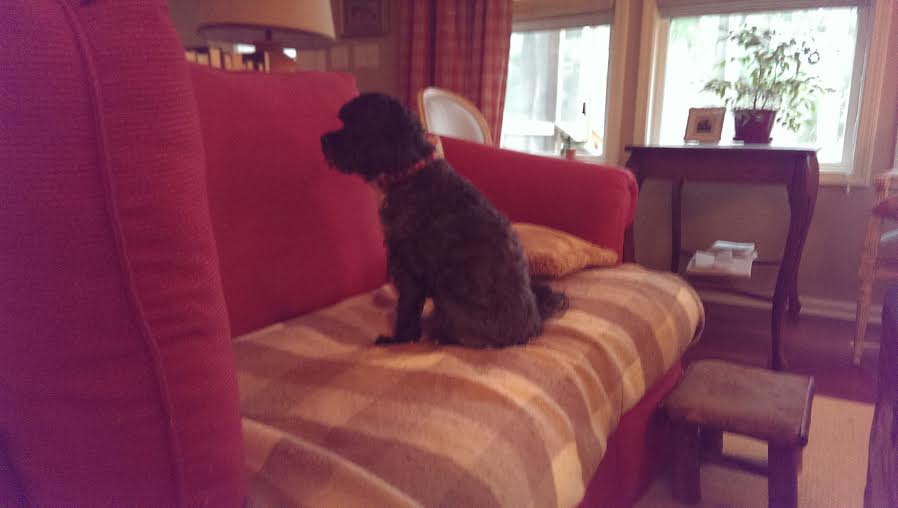
Enjoying her window view.
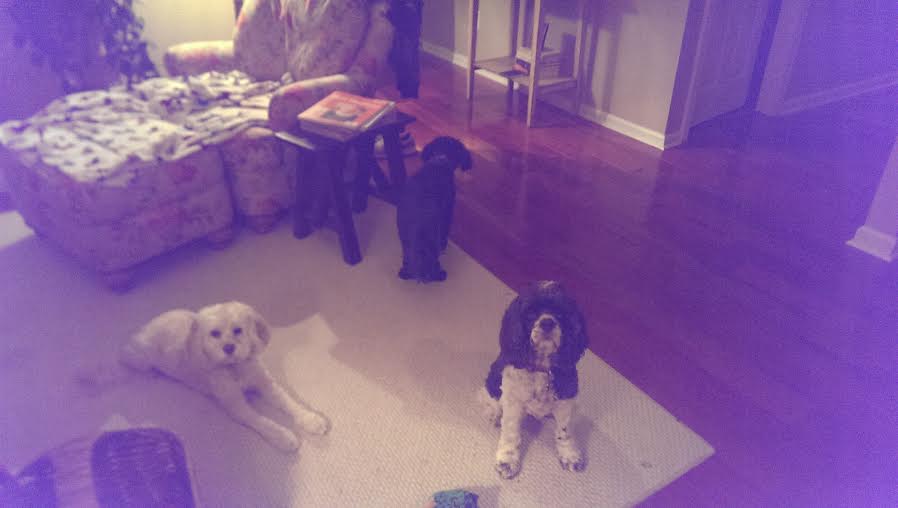
Posing for the camera.


 Lost Corner Letters
Leave a comment