
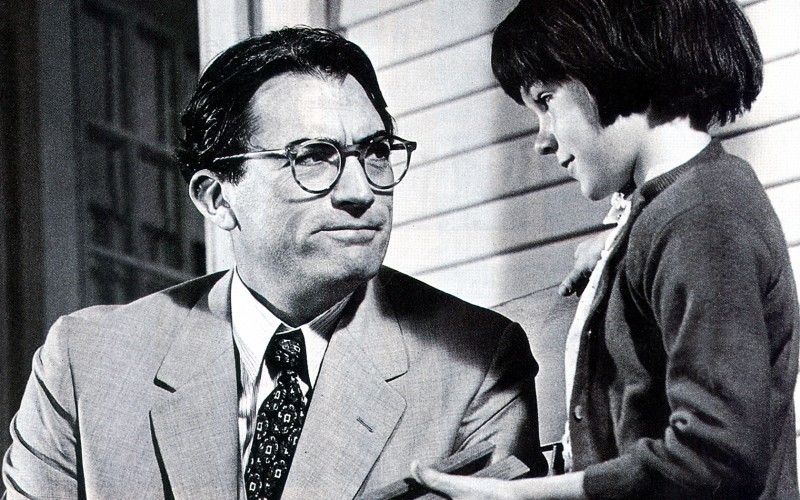
Opening Arguments
I [heart] Atticus Finch.
It’s a brave admission, I know, but at nearly 41 and single, there’s not much to lose. It is time to come clean.
Mr. Finch is Mr. Rogers meets Dr. King meets MacGyver meets Santa. He is complex. He is mine. If you, too, are a single, progressive Southern woman with the gentleman lawyer in your sights, back off. I have cousins, you know, a few the very kind Mr. Finch might take on as the swashbuckling legal stud hero he is.
Now that we have established possession, I will explain.
This man of honor has been an ethics anchor for me since I first picked up a faded black and red paperback with yellow edges in the fifth grade. Three days and three reads later, my life had changed. Atticus provided third-party endorsement of my growing notion that references to Durham as “Black Town” were simply not funny. I was knee high to a grasshopper running barefoot in the county when I began to sense a growing ache with every joke and not-so-subtle sneer emitted from people I thought otherwise to be the best kin and neighbors around. Atticus tuned me to an important dissonance, and I don’t ever want to be in accord with narrow, rural Southern “harmony” again. I simply cannot sing, hum or even whistle that melody; it is written in a negative minor key that leaves even its most loyal choir without satisfaction.
Although Atticus Finch helped set me on a course that ultimately keeps me out of tune with some I know, I am not one bit sorry we met that summer day in 1978 in my mother’s mint green living room in a 60s ranch-style house on a little dirt road in the shadow of tired tobacco farms. In fact, I am grateful each and every day.
~~~
This icon of Southern bravery and decency is fresh in my consciousness for three reasons:
- ‘A’ Is for Atticus. This book of literary baby names is a hot read now for my actor sister and her actor husband. They are expecting a small thespian soon. For most parents the name is important. For the first child of actors, it is imperative the naming be specific, meaningful and indelibly memorable. Little Johnny and Jimmy can keep on crawling; they are not to be in this family. Since the day my sister shared the title of The Book that contains The Name they prefer, all I can think about is Atticus.
- I have a friend who is the most appropriate gift giver. Recently she sent me the 7-disk audio version of Their Eyes Were Watching God. Just when I thought To Kill a Mockingbird was without comparison, there is company in the old volume’s ranks. The truth is the latter has very little to do with the former with the exception of race in the South with some drama and a courthouse thrown in for good measure. All week my eyes have been watching God, but my heart is wandering in Maycomb County.
- The third and final influence on this recent legal confluence is explained by the throng of local citizenry amassed behind this seat where I write. We are the jury pool in Durham County, NC, USA, today, the eighteenth day of August, in the year two thousand and nine. That’s right: jury duty.
~~~
Since receiving the summons, I have been excited, eager. The opportunity to serve is an honor.
Beyond a sense of civic duty or broader patriotism, for me it is a chance to enact some local justice. Now we’re moving a little closer to my worldview and motives. Surely someone has been wronged, perhaps both parties. Although I don’t yet know on which side of the equation the required justice lies, I remain confident a few cool Durhamites will find it and make things okay.
~~~
Two weeks ago, just days after moving into their new home, my neighbors Russ and Kim were robbed. It seems one can rent a truck and go into business doing one-way moving…all your things moving in one direction…out your front door and into a moving truck that someone else ordered. It is simple yet effective. Who would think to challenge an official moving truck backed skillfully into the driveway, all the while a calm, effective crew going about business?
No one questioned the men, who moved from the home and into their pirate truck a bounty that included a new flat-screen television still in the box. The catch is this unexpected “move” took place during broad daylight, with two dozen construction workers in the neighborhood, including a siding crew just next door. I will admit to seeing a moving truck in their driveway that day. In fact, I saw it backing in, and I strained from my yard to read the name of the furniture company there to deliver the new duds. Only I wasn’t wearing my glasses and couldn’t see. Worse, I smiled at the thought of this nice young couple with the beautiful baby girl receiving new furniture for their first home. “I wonder what they purchased?” I thought. Yes, I did. I sent them warm wishes of 2.2 kids, a fenced yard and the family dog. I smiled sincerely again and returned to my office.
I saw Kim the next evening standing at her front door, baby girl in tow, as some salesman talked her ear off. She called my name and spoke brightly – so brightly I felt something was wrong. It didn’t seem right, and I wondered if she were telling me she needed escape from this lingering man, inching closer toward her door. I was walking my dogs and after passing her home decided to walk in the opposite direction and then walk in circles in front of her house. Her husband was away, and this stranger had no plans to leave. No neighborhood interloper is going to bother my new friend and think he can get by with it, no sir. I made my suspicion obvious to him, completely unaware I had missed the actual ‘event’ by more than 24 hours. Turns out he was a home security salesman, and she was signing a contract.
~~~
Not surprisingly, this brazen daytime heist is the talk of the neighborhood, only the exact angle of the talk has me on edge. I’m not sure which way to face, lest I turn against the mounting winds of a coming storm. Something hostile is rising in northeast Durham.
You see, the few neighbors I have talked with about the robbery happen to be African-American, and each is convinced the Mexican construction workers did it. At the very least, if they didn’t personally do it, they know who did. It’s all about connections, you know.
Last week I met two neighbors on my daily walk, one who recently moved in and the other a neighbor-to-be. These women are certain it’s the Mexicans. While offering their evidence, they looked at the passing workers directly with a sneer that took me back to Maycomb, AL, and Atticus Finch. “You know how they are,” one said. Straight-out loathing is hard to hide.
~~~
I love facts.
- Factoid 1. I did not see any faces, therefore races, the day I saw the truck.
- Factoid 2. I am acquainted with most of the subcontractors who work in our neighborhood.
- Factoid 3. They are good and decent human beings. They give their time and spirit to Habitat for Humanity every year or so to give a family they don’t know a once-in-a-lifetime opportunity.
- Factoid 4. Most especially, the Mexican framing crews are conscientious men who pride themselves in their work, and even in having good clean fun. A few but not all are noble. They are said to be the best framers in North Carolina. They give their personal time to build for Habitat and friends and people they only tangentially know. For crying out loud, one of the crew leaders is a friend of mine named Jesus, okay? A guy named Jesus ought to be the least likely suspect, innocent until proven guilty.
- Factoid 5. Not all people in any particular group are alike. It seems obvious, but it deserves saying – in letting off the hook my fearful neighbors and in understanding that in regard to my positive endorsement of every construction worker, the women may actually be correct. One never knows.
~~~
Here is where I indict myself.
I don’t want Kim and Nikki to be suspicious. I don’t want them to be angry, assumptive or bigoted. I expect this of White people – well White folks who are not noble like Mr. Finch. They tend to be one way or the other, you know.
I suppose I want my Black neighbors to be heroes of a sort. I want White people to be different kinds of heroes. I want them all to fit neatly into my convenient little Virgo storage boxes, complete with descriptive, matching labels.
The irony is there is not much in life that is really black and white in the sense of being hard truth or easy to classify. Life is varying shades of gray. And before you accuse me of cultural relativism, I’ll say what is necessarily true, black and white, is of the law and of God. There is some Truth. The rest is negotiable.
~~~
Having said all that, I am embarrassed at how easily for me race still boils down to Black and White, and the South. When I think of race, that’s where I go. I don’t think it is a bad thing. It is exactly what one would expect based on my experience, and my all-time favorite novel, and I keep reminding myself it is my job to expand that base of experience and thought.
I have friends from Great Britain who are offended by Americans’ ease in discussing race. Even when the conversation is led by good intentions, an opportunity to understand, they shudder. “In the United Kingdom you are British, period. I am not primarily Black, White, African or anything but British.”
Similarly, my friend Benée came to work with us a few years ago. She is refreshing in many ways and easily attracts a gaggle of followers. One day we were talking about life, and I let drop my beliefs about some bigoted person or situation. The point is I made race a topic of conversation when it didn’t have to be, with all the best intentions. She paused and noted how in the South that still happens but in Brooklyn, where she was raised, people don’t do that. There I go again. The only thing more frustrating than a bold-faced bigot is a too-eager liberal who sways so far in the opposite direction that her motives are equally questionable. A continuum is really an arc, and the extremes bend toward each other to represent the same annoying person: in this case me. A scan of Benée’s office wall shows a photo display of friends and their children that more closely resembles the UN than a photo album. When I grow up I want to be Benée.
I feel like a third-time kindergartener in the school of human nature. At this rate I might earn my driver’s license while still in remedial class. I’m going to graduate to first grade one of these days, I swear it. The diploma will one day hang on my wall.
~~~
A Preponderance of Evidence
Back to the jury pool: There is a woman sitting to my right struggling to distract herself while scenes of mass murder flash across CNN on the television mounted on the wall. She hurts simply from hearing the words and looks away. [Can you guess her color/race/ethnicity? If you voted Pacific Islander, you win.] To her left is a young kid barely old enough for jury service. He is smart and thoughtful. He is reading hero fiction and drinking in every word. [African-American. What did you assume?] The annoying woman in front of them talks on her Bluetooth, as though we all want to know what’s on sale at Wal-Mart in Oxford, NC. Thanks, friend. [Color/race/ethnicity unclear.] Behind her a young woman listens to an iPod with not a single ounce of interest in the 90 other souls who share her air space. [Caucasian, brunette.] The stiff, unwelcoming man by the window is wearing red and constantly stares at me as I type. I stare back. Come on – there are plenty of security folks here; why not show some reverse hostility every now and then? [White guy.] The non-stop-talking 30-something expert on any subject one might imagine has created a literal gulf between himself and all other potential jurors, who continue to inch away in their waiting-room chairs. [Black guy.] Are you surprised?
Different angle on the same thing: Did you see the film version of A Time to Kill? (It all comes back to Atticus, Matthew McConaughey and the other legal stud superheroes.) The courtroom scene is unforgettable. Great White Savior Attorney asks the jury to reflect on what has befallen an innocent little Black girl…imagine her, walking down a secluded dirt road on the way to the store on an errand for her mother…and then being kidnapped by two drunken strangers…followed by unspeakable indignity, cruelty and pain…(I can’t even say the words)…and then left hanging to die…only to have the hanging branch break…and to be found in a river, beaten beyond recognition, near death. Imagine the horror. Now, he says…imagine she is White. GASP. Literally the audience gasped in horror at themselves – individuals of every persuasion caught off guard by the change in their own feelings, and their subsequent remorse. Some cried. I sat stunned.
Here’s another exercise. Did you know some people’s finger prints circle clockwise and others the reverse? Imagine a world in which the way God made you determines whether you are free or enslaved. Clockwise, safe. Counterclockwise, counterculture. You lose. Seem unfair? Seem unreal? It is; I just made it up. But really, isn’t it ridiculous?
Final try, and this one is personal: the clear and resounding evidence is that all strawberry-blonde dogs are inferior and should be euthanized. Putting dogs out of their misery is not exactly front-porch talk for civilized folks, and that’s why we discuss it in dark shadows and tell sly, passive-aggressive jokes. I should know. My older dogs are both black with white markings. They are perfect. Their little sister dog is blonde and red. Her fur is not as supple, her intelligence questionable. At nearly five months, she still pees on my carpet. There should be separate-but-equal facilities for boarding and veterinary care so her bad habits don’t rub off on other dogs. Really, if the strawberry-blonde dogs just disappeared, we would be better off. That’s why they are building encampments with barracks just for them until the whole euthanasia thing gets worked out. The bottom line is the different dogs’ internal make-up and canine potential are totally different, and it is totally obvious because of their outside color. Totally ridiculous.
So God made you or me with more or less melanin in our skin. And this determines our worth. Equally ridiculous.
~~~
Sidebar
I am reminded of two widely held (un)truths I learned in graduate school:
- The only people who have gender are women and gay people.
- The only people who have race or ethnicity are people of color.
Everyone else is normal.
~~~
Closing Arguments
Ladies and gentlemen of the jury, after decades of stalwart, trustworthy public service, it is time for Atticus Finch to retire. The Great White Hero, even the noble Southern lawyer hero, is no longer needed. [Note: I would like Matthew McConaughey to find a new career that keeps him in Durham from time to time. While we’re all full up with Southern lawyer stud heroes, I’m sure I can find a new place for him in my life.]
Atticus Finch belongs on my bookshelf. He is worthy of great respect and honor. He is an important marker in American history, an important feature of my personal enlightenment and unfolding. But here’s the thing: his caricature is now history.
~~~
It is no longer enough that our heroes earn their titles by doing what ought to be assumed. That heroes are made by speaking for the voiceless or facing persecution for doing what is expected of any human being is inauthentic and false. What once was considered radical is actually conservative – the most basic assumption that we guard one another’s dignity, without regard to difference, or similarity.
Further, our simple black and white world is neither black and white nor Black and White. It is every shade and texture, richly painted in hues that cannot be separated as exclusively distinct. Though I think we are supposed to keep this quiet, we all share DNA.
It is a gift that our world today, only 31 years after my first reading of Harper Lee’s classic, is so very different than the year I discovered the book. There is much improvement that can be made, yet in other ways to compare the worlds is to go to sleep on Earth and wake up on the moon. They are light years apart.
Nobility is no longer defined by keeping watch at Tom Robinson’s jail cell all night. Our best starting point is to look inward and to understand our own prejudice, our own need for heroes and our anger. It is to understand that no one type of person is ‘normal.’ Every single individual represents his or her own unique cultural perspective. I am an Italian-American woman in North Carolina. My friend Nora’s Italian family from New York could not be more different than my own. At times we barely speak the same language. Even our Italian-ness is different. They call themselves Guineas, and we are WOPs.
~~~
Interesting I should choose the Violas and Marinos for this comparison. Something happened with my friend Nora and me at work several years ago. We were traveling with our job in a rural community of cotton and tobacco growers. Driving down a two-lane highway, we met a funeral procession headed in the opposite direction. Nora kept driving, as though the convoy of law enforcement, hearse and creeping vehicles did not exist. I did not have time to think before essentially scolding her, “Nora, stop! No, really, pull over!” I who don’t take things personally was deeply offended. Mostly I was shocked and ashamed. We were disrespecting these mourning strangers, our distant neighbors.
Nora retorted with equally strong feelings on the matter. “I don’t know the person who died. They aren’t my family.” This from the woman who says on a regular basis of her fellow New Yorkers they should try harder to blend in down South. They chose to come here, after all.
I was a nauseated mix of deeply rooted beliefs, all shaken up. I felt like Humpty Dumpty. My insides cracked.
My point is that every human being holds his or her own unique cultural identity. We are independent nation states trying to get along. Let’s look at the math.
If a person takes two dice, six sides each, and rolls them, there is a 6×6 chance you’ll get a particular set of doubles. That is, there is a one in 36 chance both dice will show a particular number. Similarly, let’s say there are 100 unique human characteristics that help define the individual. The fact is there are infinite markers for a person’s identity, but let’s take the conservative route. The chances any two individuals would be the same = 100×100. There’s a one in ten thousand chance two different individuals can share the exact same set of human characteristics that define ‘culture.’ To be realistic, one has to accept there must be 1,000 and not 100 factors, so the probability of the same circumstances existing in two people is one in a million.
However, and this is where it gets good, all this damned math assumes it’s a quantitative calculation. The truth is there are bazillions of things that make us who we are, and the interaction of these things is what gives them unique meaning, at a specific point in time. The whole is greater than the sum of the parts. It is four-dimensional. For two people to share the exact cultural heritage is nearly impossible. A Lutheran woman from Minnesota with a husband and two kids is much different than the same woman as a single mom…or of a different race. What if she is a Swedish Lutheran, or a Dane?
So whether you get there by God, math, common sense or intuition, we are each necessarily culturally diverse. I’m not just any White girl. I am not Nora. I am not even my blonde dancer actor sister, Karen, in Queens. I am me and me alone. Sure, I share some characteristics with other groups of people, but in the end, I see the world through Mitzi-colored glasses.
Before I can learn to tolerate and even appreciate other people, including those who don’t stop for funeral processions, I must first know what informs my beliefs. I freaked out over Nora’s perceived faux pas because of one unique life experience.
When I was 16, my dear uncle, Robert, died. His funeral was at Friendship Baptist Church in a one-stop town outside of a three-light larger town on a pine-dotted farming plain located halfway between here and there. This meandering string of vehicles carrying extended family stretched across a narrow road, past fields and thick forests. As my family drove in silence from the church to the cemetery, we met other vehicles. Each one – every single one – turned on its lights in solidarity and pulled off the road. Farmers in their fields dismounted their tractors, took off their hats and stood at attention as if they were pledging allegiance to the flag. They were pledging allegiance to Robert, to the passing of faithful servants everywhere, and to their Maker. Some knew Uncle Robert; others did not. They all honored him. I am not one for great emotion. Don’t get me wrong – I have feelings and hold great feeling for others. But I’m a thinker. I ponder a thing rather than going there. I write it down, think some more and move on. And riding down that rural highway in the back seat of my parents Buick, I cried openly. I vowed never to forget the respect that dozens of strangers showed us, and my sweet Aunt Inez. I was completely overwhelmed with the Good.
Now, Nora and I didn’t exactly have a chance for the encounter session in which we could share our experiences and feelings. We each got pissed off at the other and silently rolled our eyes in frustration as we shared an uncomfortable ride in a small car for the rest of our business trip. This from two single Italian-American friends of similar age, with similar humor, working for the same agency. In that moment we could not have been more different. Now imagine her skin is purple and mine is green, or that one comes from relative privilege while the other does not. That just changes everything.
~~~
And so what in the world is the current Truth? Let’s break it down.
It is hard to address without having things become too personal, too political or too something else.
Therefore I have decided to go with religion and literature, but not in that order.
MAYA ANGELOU: People are more alike than unalike, and what is true anywhere is true everywhere.
GOD: I don’t make junk.
The Angelou nugget explains itself. It really is the ‘what’ in this equation. The God piece, on the other hand, is the ‘why.’ It is also the ‘why all the noise does not matter in the end.’ Ultimately, our categories and divisions are penultimate. We major in the minors; we miss the point. Every single person is made in the image of God, all equally worthy and created to be equally valued, if we dare. It matters not the circumstances into which we are born or the choices we make. We sin. We fall short, and we are all God’s most important kid – every single one of us.
I wonder if we viewed the grid differently – across the Y axis instead of X – if this would change things. Rather than draw lines by shade of skin, gross annual income or other external markers, what if we grouped people based on behavior and character. Brilliant. All the tailgaters fall here…and community volunteers there…and so forth. The liars, the faithful, we all earn description based on how we act, not how we look. Golly, it seems so easy. The reality is that inevitably our judgments are steered in the moment by a [unique] lifetime of experiences. We act or react with alarming predictability. All we can reasonably influence is the breadth of our learning experiences, our own teachable moments. And it’s on us to find them.
~~~
A Surprise Witness
To honor the specific is so much more important than to describe the general. Individuals, by name, matter. There is one I met in the jury room today who matters tremendously. The peace lily in my living room belongs to her. It is a complicated tale – and just the kind that convinces me more and more that we are guided from above and cared for deeply, although we often fail to recognize our daily miracles. We miss the cues. The evidence here in the Durham County jury pool room cannot be missed.
A small group of potential jurors had gathered outside the locked courthouse when I arrived, ten minutes before the instructions on my summons. We early birds stood in awkward silence, sizing up the gathering cohort. Two women welcomed my eye contact and spoke easily. We laughed, and our conversation loosened the crowd. A third woman arrived who seemed familiar, as if I already knew her. I nodded and smiled. There was a brief moment of recognition before she looked away. Upstairs in the waiting room, we met again. I had excused myself from my writing desk, one of the few good seats available, to find the bathroom. When I returned she had taken my seat. Imagine! No matter, she was working the Sunday Puzzler, and I have great respect for anyone who shares the habit. She was older than me, and I had taken up space in the Class-A seat long enough. I could stand for a while.
When the seat next to her later opened, I moved in. I asked if we could share the table so I could type. “Of course,” she said with a smile. From there the conversation unfolded with ease. We liked each other but still did not know why. I began my foreseeable habit of asking questions.
“What would you be doing if you weren’t here today?” She answered that she was scheduled to be off work.
“Where would you be if you weren’t off work?” She looked directly at me without speaking.
“Where do you work?” I clarified. There, I had her cornered!
“A hotel,” she countered. She had eluded my grip. She was not yet captured.
“Which one,” I continued.
“A hotel, in Durham.”
Finally, the snare: “Which hotel?”
The woman smiled and spilled her secret, “The Millennium.”
“My father worked there in retirement. George Viola.”
“You’re George’s daughter? We shared an office. [pause] I was so sorry to hear he died.”
In amazement I asked, “What’s your name?”
“Antoinette.”
“He loved you so much!”
“And I loved him. I teased him that you girls were my stepdaughters.”
On and on it went. Through excited couplets we painted our shared history in small, colorful strokes. We laughed and talked for hours to the surprise of the 30 or so people who sat isolated in their own personal bubbles, still waiting to be called to a courtroom.
We learned that we share much more than my father. Our birthdays are four days apart, both events to occur this week. We are on the Leo/Virgo cusp and believe we have spent too much timing living like Virgos; time to ease the standards and live a little. We like crossword puzzles and enjoy our paper’s Sunday Puzzler best. We are loyal to our families. We are members of the same church, though I no longer attend.
I showed Antoinette the salute to Dad I wrote on the funeral home Web page. She nodded in solidarity while reading, and I cried, almost my first tears since his death. She told me his former coworkers still find paper airplanes he made and tucked away in dark corners to be found in the future. He liked to make people smile. Antoinette laughed as she told me he occasionally took lodging airplane pilots to the second floor atrium at the hotel, and they launched paper airplanes into the lobby. He was loved and often sought out by returning guests, including these pilots and the families of patients at nearby medical clinics. He was loved for his Good, and I was so pleased. I shared that his family relationships had been strained at times for a breach in his Goodness and that I so appreciated the love his friends showed him when some of us were distant and unable to do the same. She nodded.
She said, “I gave him a plant, a peace lily, when he had that surgery a few years ago.”
“I have that plant at home in my living room,” I replied. “It survived his dark house and sporadic watering. My puppy ate the bottom leaves, so I just this week moved it off the floor. You must have it back for your birthday.”
“Okay.”
I work one block from the courthouse, and I knew just the place for lunch. We did not invite our fellow waders in the now shallow jury pool because there were further things to say. Lunch revealed more similarity, including our love for a local Mexican restaurant and its manager, Juan, himself a lively conversationalist on race. I learned her mother died two years ago, in the same month Dad died. She also has two siblings. On our walk back we met some of my coworkers in the parking lot that separates the restaurant from our office. I introduced her as “an old friend” and “a member of the family.”
The reason this matters in a piece on race: she is African-American, and I am White. And not one time during our six straight hours of conversation did it cross our minds. We are so in sync, apart from our love for Dad, that noting a superficial difference is hardly the point. Maybe I’ll graduate from kindergarten after all!
It is not actually a surprise that Antoinette or I would have a color-accepting or race-acknowledging conversation. The surprise – the hope I offer with this illustration – is that she and her former supervisor, Charlie, were among Dad’s most beloved friends, and they are both Black women. Dad was raised in a Southern mill town and told his share of questionable jokes about women as well as people of color. His professional career path with IBM broadened his experiences and, incidentally, flattened his Southern accent. He was not Atticus Finch. At the same time he was no David Duke. He was human, and he changed for the better over time. Perhaps this is the new definition of nobility vis-à-vis race. He grew.
When Dad accepted that he would soon die from his cancer, he began asking for his friend Charlie. She had changed hotel jobs, and he was too sick or confused to remember where she went. My sister found her just before he died, and the day he left us, Charlie appeared at his bedside in the critical care unit. He joked that if anyone gave her trouble for being present and not being family, she was his other daughter. “Girls, there’s something I have been meaning to tell you…” This time the joke about race was funny. It was an admission or grace note that highlighted his transformation. Charlie’s presence at his deathbed healed a life-long wound he had been treating with the salve of friendship. Very slowly, over time, Ron from IBM, Antoinette and Charlie at the hotel, his neighbor Ramone and others in his life moved him slowly and deeply inside. He chose to replace some of the beliefs that once filled his inner space with more current views, more honest assessments. He refreshed his personal landscape. Out with the stiff magnolias and in with a more colorful bouquet.
That is powerful testimony.
~~~
A Life Sentence
There is not a verdict in this case. The jury is still out and will remain that way. There is no guilt or innocence, no justice to dispense. In short, differentiation based on appearance, and subsequent judgment of value, will continue to happen. It always has and always will. What can change is our willingness to grow like my dear old Dad, to expand our horizons in small degrees.
Why does it even matter? If it is not the point to label or limit one another, yet we are asked at the same time to consider the unique viewpoint of each person, what are we really asked to do? It is confusing. The whole notion can seem self-defeating or contradictory.
One thing I know for sure is it is a process, not an act, and it is not happening quickly. Every day we inch a little further along the path. We are anthropological slugs.
Still there is something missing.
~~~
There’s a place called Koinonia Farm in southwest Georgia. It is the home of the theology that gave birth to Habitat for Humanity. A Christian community, literally a commune, founded in 1942, Koinonia remains a quiet but radical force. A full decade before school integration, this unlikely place proclaimed itself “a demonstration plot for the Kingdom of God.”
The theology of this experiment in Christian living can be crudely boiled down to this: live the Gospel. The small community of Christians made its daily decisions based on one question: “Does it represent the Gospel?” Sometimes you know you are doing the correct thing when something so easy causes a whole heap of trouble. That’s how you know a thing is True. The town boycotted Koinonia, and the Klan even visited. Things got all stirred up just because some farm hands had lunch together, workers of different races sharing a noon-time meal, because color-blind hospitality is what the Gospel requires. More radical was that all field hands were paid the same wage, without regard to race.
How Habitat came from Koinonia is a longer story, but the two share a few things, most importantly, theology.
~~~
An early Habitat leader was a guy named Tom Hall. He was special because he served as the theological father of Habitat, a force of stability in the organization’s early, more tentative days. He is also special because he hailed from North Carolina, a fellow Tarheel. I had the honor of knowing and working with him ever so briefly nearly 20 years ago.
Tom summarized things, life, when he was diagnosed with potentially terminal cancer. He had Five True Things to pass on to his children and his Habitat family. One of these five things ties back to the intent of Koinonia Farm: If life is worth living at all, spend your time wishing and working only on things worthwhile. Tom took it back to the Lord’s Prayer. He said that when we pray “thy Kingdom come, thy will be done, on Earth as in Heaven,” we ask a very powerful thing. For God’s Kingdom to be reflected on Earth means each decision is made according to the community at Koinonia. What makes my community look more like God’s Kingdom on Earth? In Durham it means healing the division of the downtown communities created by the construction of the freeway; it means fixing a home-ownership rate that keeps the city’s neighborhoods unstable and its children unsafe.
So that is the framework for the conversation on race and humanity that I prefer: what makes the world look more like God’s Kingdom on Earth. Often it’s the small stuff such as giving eye contact to a stranger or talking with a Habitat family rather than to them. It is being open to the gifts they bring to me through my work and keeping watch for the deceptive illusion that I’m some Daughter of Atticus who necessarily has something to offer them, something they necessarily need. That is an ugly delusion.
~~~
Who are ‘they?’ Humanity. All the creation of God. Anyone, everyone. You and me.
When I talk about Habitat for Humanity, I get really excited about all people being of equal value. I mean, who believes a child deserves to be born in a garbage dump outside Guatemala City? God just doesn’t make junk. That some are born there and others into relative wealth is a crap shoot. No one deserves either situation; we get the cards we are dealt. It is not fair. Habitat is a means of making things right, of restoring the karmic good. It is one of the world’s great equalizers, and everyone can find a way to participate.
Taking it back to Koinonia Farm and Tom Hall, if we assess the situation at hand, call out the unjust and then act to make it right, that’s the job of life. No, the job of life is living. Creating justice and drafting a new vision for life right here today is the job of worship. I don’t think I have ever used these words, so take it easy on me, please. I’m still working out a new concept.
If a great, good, loving force created us, then the art of the Creator is everyone and everything we encounter. The highest service to the Maker is to fine tune the details. Antoinette and Benée are equally valued and loved by God. The same is true of my friend Henry who sells the newspaper at our friendly neighborhood Biscuitville. Same for the Bushes and Obamas. The same is true of the jackasses who robbed Russ and Kim’s new home the week they moved. All precious. All made in the image of God. Each God’s most important kid.
We are each meant for a purpose. Our earthly challenges slow us down and prevent us from accomplishing that purpose. To help another along the path is to serve and worship the Creator. It is the tax we pay for living.
Conversely, and I believe this with all my heart, when we hate another of God’s creation, in that moment we choose to hate God, at the very least to deny God. And most of us do it every day.
~~~
I seem to have strayed from Atticus Finch, but maybe not. Racial injustice and even the day-to-day misconceptions that cloud our thoughts and actions…about the ugly people, the fat people, the retarded people…all superficial classifications that carry price tags of diminished value matter. These injustices are bastardizations of God and the Good. When we limit or injure sisters and brothers, we ourselves ultimately feel the pain. It is our problem – all of it.
I have spent a lifetime frowning internally about Christian friends and relations who are also racist. This one is hard to swallow. Many in my family are religious conservatives. Many are openly racist. I want to ask them, “Where’s your Bible? Have you read it lately?” I don’t mean to assert that I have because I have not. The irony of a group claiming direct contact with God through the literal Word of God who literally do not understand or enact what they read – it pisses me off. Perhaps they also didn’t graduate from kindergarten. How can you hate people, the children and handiwork of God, and say you love God?
And there I go myself, judging and hating. Their sin is ultimately no greater than any of mine. To know me is to accept that this internal struggle is part of my unique cultural heritage. I am caught between a sometimes limited family and an enlightened education of theological grace. The rock and the hard place, it helps inform who I am. It is this tight spot that sparked my interest in Atticus Finch and that keeps me aware and writing. It prescribed my nonprofit career. I guess it’s not all bad.
~~~
It is worthy of mention that if we do not love ourselves and care for our own beings and bodies as deeply as we care for Tom Robinson or the kid born into the Guatemalan garbage dump, that is an equal bastardization of creation. To deny ourselves dignity and care is also to deny God and the Good.
~~~
The evidence is both local and global. Down the street real Black and White and Other racism continues, though our world is more sophisticated than the Maycomb of old. There are still kids whose very potential is limited because of outside expectations of their worth, because of the amount of melanin in their skin. They have not been told God doesn’t make junk, only that their hair may not be as “good” as someone else’s hair or that their teachers treat them differently. The message is often unspoken yet loud and clear.
Somewhere beyond us there are children born into and dying inside a garbage dump outside Antigua, Guatemala. If we were not so damned busy jockeying for position within the North American crayon box, we could join together to help. There are plenty of us of every color and means who could influence the situation, but we are distracted.
The Guatemalan tragedy is complicated and gray. Untold factors contribute to this level of poverty. Farther across the globe there are entire races of people at risk of death for the way they were born. The Holocaust did not begin or end in Germany. There is Kosovo, Sudan and even the highlands of Vietnam where Montagnard fathers still flee their homes in the dark of night because of their families’ roles in helping U.S. troops during the Vietnam War. There is Burma, Gaza and our Native-American reservations.
I believe the Latina kid in Durham who hears directly or indirectly she is worth less than other children experiences just as significant an injustice, an equally negative deficit against the Universe’s bank of potential, as the latest, greatest genocide.
~~~
Sometimes as I drive the city or follow the news, I imagine where in this world lives the next Einstein. Is it that garbage dump or a place more likely to nurture Little E’s innate potential? Around the bend or across the ocean lives the next Mozart or Bach. How many prophets were killed at Auschwitz? We will never know. Only God knows, and surely weeps for each one.
Imagine the potential lost to lynching and fear, to low self-esteem over who gets “good” hair and high-yellow or so-called blue skin coloring.
I do not have children, and I cannot imagine the love a parent feels for a child. The instinct to protect and defend must be tremendous. I imagine this is how God feels for each of us. The kid living in the Weaver St. projects in Central Durham was meant for greatness the world will not see. Can you imagine how his Maker feels about that? Do we remain open to him, or do we assume him a thug-in-the-making when we meet? What if he wears his pants low, or drives a pimped-up car? Do we actually know that his potential is limited, or do we make the assumption based on his appearance? Do we lock our car doors when we see him?
~~~
It is overwhelming. Thinking too much makes me want to crawl under the covers and never come out. Here is one way to make it achievable, reasonable. They say that behind every good man is a good woman, if you’ll pardon, or not, the sexist generalization, ironic in an essay like this. Behind my friend Tom is his wife, Dianne. Hanging above the kitchen sink in their home was a plaque that read, “Reaching one person at a time is the best way of reaching all the world.” Now doesn’t that feel better? It’s the truth, too. In fact, there is no more sustainable way.
A former colleague once called this approach “starfish throwing,” the assessment pejorative. Her hypothesis was that with appropriate efficiency, we can help many more beached starfish while standing on that lonely shore, tossing them back into the ocean of life. The one-at-a-time approach is passé.
I happen to disagree. Thinking about it, it seems to me the Hall family approach is akin to the Eastern mindfulness that continues to elude me. Being present in *this* moment + the Hall philosophy of one at a time = a children’s book a former colleague likes. I don’t remember the title or its third thesis. The first two points go like this: 1) the most important person is the person you are with; 2) the right time is now.
The risk of Western thought is ‘all or nothing.’ I tend to throw myself headlong into saving some situation or other only to burn out. I can’t do it all, therefore I end up doing nothing. Perhaps I do it, and do it so well that for the next six months I try to recover my personal energy. I just gave it all away. Hegel said we swing from extreme to extreme, from thesis to antithesis. Eventually we find synthesis, just before swinging back toward another thesis. Unlike the Western path, the Eastern approach allows everything to be as it is, as we find it. Mindfulness counteracts the anger that comes from looking backward and the fear of looking too far forward. It is beautifully sustainable.
So if we apply this approach to our brothers and sisters – all people, in their varying shades of similarity and difference to us – we get some place close to being the personal Atticus Finch for ourselves and everyone we encounter.
~~~
By now I have exited the Durham County courthouse. Not having been called to active duty, I’m a little disappointed. I took a drive to Mayberry this evening. I sat at the soda shop counter and had a long talk with an old law-enforcement friend to help make sense of the day. This friend, Barney Fife, had one suggestion: deputize everyone you can as a mini Atticus in his or her own little world, a mini me, if you will.
Laugh, it’s okay. The one-bullet walking inferiority complex has a point. Atticus himself is not flawed. He was a suitable and needed hero in his day. Hell, he was radical. It’s just that this is no longer his day. A cross section of society now reveals a stunning kaleidoscope; back then it showed something that more closely resembled a checker board, with clean lines and simple patterns of color. Atticus Finch was just right for that time.
In our time, the best we can do is to seek to understand one thing from each person we encounter: what is it like to be you? A graduate professor taught me this approach as it relates to the constructivist theory of mental health counseling. Tell me what it’s like to be you.
If we take the time to sit and listen, to observe, to walk around in someone’s flip flops, we just might get somewhere. We do not have to agree with them; we are simply asked to hear and to try to understand. The ripple effect of this modest act is grand. If you’re bored some time, listen to “On and On It Goes” by Mary Chapin Carpenter or “Echoes” by Dar Williams. Each tune tells the tale beautifully.
~~~
Here is a final take on Atticus before the thought leaves me, and I really like this thought.
My father’s nobility, it seems, was defined in part by his growth with regard to people. He traveled a million miles from 1935 Small Town, NC, to the more enlightened position he held when he died. One can argue that I began life almost farther down this road than he ended life. The world into which I was born was kinder, and I was blessed with good mentors and grace-filled experiences. Yet the path Dad took was filled with obstacles. It is as though he walked backward to the moon; the odds were against him. If I were to start right here and set my spiritual GPS for an equally unlikely distance into the stratosphere, I might shoot right out of kindergarten in my rocket ship and land in middle school.
My father almost makes Mr. Finch seem less grand.
~~~
I hope there is no required waiting period to wear my new badge. The canine culture at my house, my three pack, has exploded and draws me to conclude this epistle. The two older, perfect black dogs have been harassed by their puppy sister to the point of war. The blonde and red tyke, not yet imprisoned in that separate-but-equal facility, is a ball of fire. She lunges and barks at them, anything for play and attention. The older dogs are both half blind, and they are not amused. My inner Atticus is up for the challenge.
The dogs have nicknames you might recognize. The oldest, a shy creature that sometimes hides in dark corners: Boo Radley. The middle one, an eternal precocious tomboy: Scout Finch. And the little one, my blonde mutt with red highlights who came to visit from a distant land one summer, the short kid with the squeaky bark and funny ears: Dill.
It is time to make my house look more like God’s canine Kingdom on Earth.
~~~
Make the most of your life sentence. It is the only one you get.
Know yourself. Understand where you come from and how this colors your view of the world. Admit and embrace your prejudice. Take it apart. Let it see the light of day. When you think you have it down, delve a little deeper. Don’t ever stop learning.
When you see Boo Radley on the road, talk with him. I had this experience just recently with an autistic kid in my neighborhood. Before meeting him, I believed he was disorganized and psychotic, perhaps dangerous. I could not have been more wrong. He is shy and endearing. If you tell him your birthday, he will tell you the day of the week you were born. You’re looking at Tuesday right here! And don’t think I looked past the surface to seek him out immediately. Instead, I avoided his confusing behavior a full year before finally breaking the ice.
A little insight changes the way we see everything and everyone. Each day it all becomes clearer, less fearful. We have a chance at a new, improved life with every rising of the sun. Our calm attention and understanding, even when it is difficult, are a service to the world and a way of honoring our Creator’s work. We are a little more complete, more what we are uniquely intended to be. We make the world look more like God’s Kingdom on Earth, and that is some really good justice.
I conclude in gratitude to Harper Lee, Atticus Finch, Dad, Tom, Dianne, Jesus, Benée, Nora, Antoinette, Charlie, Koinonia Farm, Habitat for Humanity, even Barney Fife, and all the world’s every-day superheroes.
Case closed.
© Mitzi Viola, 8/25/09


 Lost Corner Letters
Leave a reply to Jen Cancel reply