
“Power tends to corrupt, and absolute power corrupts absolutely.”
(Lord Acton)
You have likely heard the quote. If you are human, alive and have some gray hair, you have also likely had a dose of personal experience.
To find a few good examples of power run amok, one need only scan the news headlines of the past year.
Financial titans deceive, steal and lie. Trusted coaches and clergy abuse innocents in their care. Countless others aid and abet. To kick Rome while it’s down, the Vatican’s recent “doctrinal assessment” of American nuns rebuked the group for spending too much time “promoting issues of social justice.” An archbishop was appointed to “take control” of the women and cleanse them from their sin of following Jesus in lieu of church doctrine. It seems even the Absolutely Good among us are having a tough year.
No group is immune from the risk of authority unchecked.
Lord Acton was uniquely suited for his astute insights on power and corruption in religious, political and everyday life. An English Catholic historian and politician, he was the grandson of a Neapolitan admiral. He was also an intellectual, considered one of the most learned people of his time.
This informs the context of our opening quote. It is Lord Action’s 1870 objection to the First Vatican Council’s broadcast of the doctrine of papal infallibility.
“…I cannot accept your canon that we are to judge Pope and King unlike other men, with a favourable presumption that they did no wrong. If there is any presumption it is the other way, against the holders of power, increasing as the power increases. Historic responsibility has to make up for the want of legal responsibility. Power tends to corrupt, and absolute power corrupts absolutely. Great men are almost always bad men, even when they exercise influence and not authority, still more when you superadd the tendency or the certainty of corruption by authority. There is no worse heresy than that the office sanctifies the holder of it…”
Lord Acton is also credited with some nuggets of secular truth that hold their relevance across centuries.
- “The issue which has swept down the centuries and which will have to be fought sooner or later is the people versus the banks.”
- “Every thing secret degenerates, even the administration of justice; nothing is safe that does not show how it can bear discussion and publicity.”
- “Liberty is not the power of doing what we like, but the right of being able to do what we ought.”
Yes, Lord Acton. Absolutely!
+++
Understanding of corruption and power can be gained through several fields of study – philosophy, theology, history, political science and even the school of common sense.
I prefer math – specifically statistics.
Let’s take a look at a few concepts.
+++
I. The continuum
You know how it works.
Draw a line. Place two seemingly opposite words at each end.
In truth, a continuum has no end, so place arrows on the ends to represent movement toward infinity. Now step back and take a look.
<–bad——————good–>
<–white——————black–>
<–high——————low–>
~
II. The arc
The fact is mathematically a continuum is shaped like an arc – a line forming a circle that never quite touches.
Bend the ends of your continuum down until the arrows almost touch in a nearly perfect orb.
Looking at it this way helps explain a truth of supposed “extremes” – they are almost the same.
Look at it linearly:
<–most conservative——————most radical–>
When you bring the ends downward into the arc form, you see clearly that the uber-annoying liberal politician and the uber-annoying conservative are pretty similar in some respects. Perhaps they lean soooo far in one direction that rational conversation is not possible. Perhaps their need for control of your mind or their refusal to recognize all the facts makes them ironically identical.
In debate and in politics this extreme “thinking” is called ‘reductio ad absurdum’ – to reduce an argument to the point of absurdity. We all know the guilty on both sides.
I don’t know if philosophically the near extremes really are necessary, but if one exists, I’m sure as hell glad the other is there.
Mathematically, both (near) extremes are required.
~
III. The normal curve
Now let’s populate the continuum.
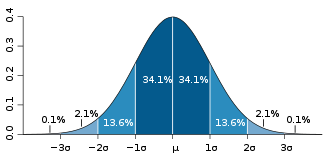
View it again in its linear form. Next, superimpose the normal curve right on top of it. Here’s a visual that will help:
 <–bad—————————————————good–>
What you’re looking at is the probability density of distribution of any ‘thing’ or characteristic in our world.
The near extremes fall on the ends (but remember the continuum never ends). The sweet spot in the middle is the norm. The measuring cups for this recipe are markers we call ‘standard deviations.’
About 96 percent of life falls within two standard deviations of the norm.
The so-called ‘extremes’ consist of only 2.2 percent on each end.
This means in any argument, discussion or comparison, about 96 percent of life is some similar shade of gray. Very little in life is as extreme as Black or White, Good or Evil. In fact, the extremes don’t actually exist in earthly life.
Taking the bad/good continuum above + normal distribution = all people are a mix of good and bad, and extremes in behavior (Mother Teresa and Hitler) are very rare.
The completely Good or Evil human being does not exist. Sure, sociopaths get close, but none of us is literally an angel or the devil.
There are entire religious canons and social sciences to explain what the math can show in a snap.
Probability density rocks.
[NOTE: There are people of fear whose response to this theory is to call me a ‘cultural relativist.’ People like me have no moral anchors. To the likes of me, they say all things are relative, gray. To the contrary, I believe strong in a few things I believe to be Absolutely True. They are of God. I’m talking here of Earth. Do us all the favor of leaving Reductio Ad Absurdum at home so we can continue to talk, pls. Thx.]
~
IV. Pattern in motion
The German philosopher G.W.F. Hegel took another step forward in theory by suggesting a pattern of movement across the continuum.
His hypothesis, called the Hegelian Dialectic, looks like this:
(1) Thesis
(2) Antithesis
(3) Synthesis
Let’s take an example from everyday life that most of us understand. How about…dieting? The Hegelian Dialectic suggests our diet behaviors follow this pattern:
(1) Restrictive eating
(2) Gluttony
(3) Balanced eating
According to Hegel, we swing from extreme to extreme, finally finding balance before swinging out to thesis, and the resulting antithesis, again. In this example, you might switch the positions of #s 1 and 2. This pattern is equally valid.
In daily life, the Hegelian Dialectic might also look like this:
(1) Traditional ‘50s culture
(2) The “free” ‘60s and ‘70s
(3) 1980-something “average”
In the political realm, we might apply Hegel to the changes of the Arab Spring.
(1) Strict dictatorship
(2) Revolution
(3) Synthesis government
Keep in mind here the extremes are said to be eerily similar. Consider the danger of an “evil dictator.” Now consider the danger of the subsequent revolutionary leadership. Remember Lara Logan in Tahrir Square. The dangers of extreme control vs. no control near the ends of the continuum are not that different.
Are we bound to this pattern? I’m not so sure. If you think about it, it’s really a Western trait to swing from extreme to extreme before finally hitting the middle. Too hard…too soft…just right.
There’s something we can learn from Eastern mindfulness that might interrupt the pattern.
An interesting footnote is a continuum I recently saw in a book that suggests cultural values of individualism (vs. collectivism) might be the mitigating factor. This book is written about something different altogether. However, its continuum of cultural identity looks like this:
<–U.S.———Japan———China–>
(individualism) (collectivism)
Balanced Japan resides in the mindful middle. Interesting.
+++
Enough theory. Even the numbers have their place
Let’s stroll across campus from statistics class to the theatre department and bring these concepts to the stage.
Remember, we’re talking about the patterns and nuance of power and corruption.
Act I
There’s a business we’ll call ABC Widgets, Inc.
In the opening scene, strong-handed President Jones rants in an all-employee meeting.
“WE WILL NOT HIRE ROUND, TRIANGLE, PURPLE WIDGET MAKERS! That is the ABSOLUTE LAST thing this company stands for. We have a board that will not allow this. It is against our corporate values. There will be ABSOLUTELY NO round, triangle, purple widget makers here!
As a corporate board, the trustees have little contact with staff and other key stakeholders. They have financial investments and make key decisions regarding direction. Only the President is operational.
To their credit, the board sometimes asks President Jones about staff morale.
“They are happy,” he says.
Production is up. The bottom line is good. All is right with the world.
Act II
President Jones retires.
The board learns things were not so happy internally. Worse yet, the numbers were inflated. Things are no longer rosy for ABC Widgets, Inc.
The trustees and shareholders meet to discuss one question. How did this happen?
The answer is obvious.
To counter the strong hand and values of the former dictator, the board replaces him with none other than – get this – a round, triangle, purple widget maker turned Executive! She broke through the glass ceiling and now resides in UPP – the Ultimate Power Position.
Things are going to be different.
There is no corporate management present for the meeting.
Act III
Fast forward into the UPP Presidency, and things are no different at all.
While President Jones ran the company from his unique personal value system, President UPP runs the company from the reactionary position. Her ONLY motivation, besides rising farther UPP, is to undo and prevent the sins of the past. In the UPP world, any hint of any reality that resembles before is to be strictly eliminated. The entire purpose is to erase the past and all things personal. It is all one big personal reactionary agenda.
Whereas the past involved too much personal value input into corporate decisions, this time there are NO personal values involved in leadership – or any values at all for that matter. There are no standards for behavior. Work is strictly impersonal. In fact, the culture is now strictly inhuman.
President UPP meets with the board. Internal systems are improving. Production is increasing.
“How are the employees?” the board asks?
“They are happy,” she replies.
Act IV
After another leadership crisis, the board gathers to re-evaluate. They ask the age-old question.
“Our second president was so different – in fact, exactly different. How did it happen again?”
Evaluation
The answers seem clear to us as readers of the four-act play. After all, we are observers with no personal investment. Here’s a summary of lessons our play delivers:
– The strong-handed dictator and controlling reactionary are extremes. They are so extreme that when you view the continuum as an arc, they nearly touch.
– What the situations share in common is this:
- In both situations the leaders’ primary motives were personal and not the mission of the company.
- In both situations there was not a communication process that allowed employees to connect with the board. The Presidents spoke for them.
- Both times the board asked itself the age-old question, “How did this happen?” Neither time did they ask any key stakeholders or collect the wisdom of the people with direct daily involvement.
Hegel would chart the company similarly to the Arab Spring:
(1) Controlling dictatorship
(2) Controlling reactionary
(3) Synthesis government
Some thoughtful processing might have made the swing to antithesis unnecessary. Perhaps a conciliatory synthesis leader could have been the second step. They have instead given him twice the mess to clean up.
To the board’s defense, having a role in a thing changes the game. What seems clear from 30,000 feet is not as obvious when you are in the midst of enacting change.
+++
All of this discussion of how institutions relate, and sometimes fail, is one thing. Why is a more appropriate point of discussion.
THE UNIVERSAL PROBLEM is summed up by our old friend Lord Action. “Every thing secret degenerates, even the administration of justice; nothing is safe that does not show how it can bear discussion and publicity.” That’s right, secrecy is the monkey in every such situation. The fact of control of a people is one thing. What the world believes – what the world is told – is something different.
THE UNIVERSAL SOLUTION is summed up by the motto of my alma mater, ἡ ἀλήθεια ἐλευθερώσει ὑμᾶς. “And the truth shall make you free.” Communication structures, checks and balances, independent audits – anything that shines the light of truth is a preventive tool or antidote to power run amok.
+++
Perhaps the most important point is that we all already know everything needed to prevent danger. Here’s the quote by George Santayana: “Those who cannot remember the past are condemned to repeat it.”
Here are three examples from the history books:
- This one is less about the corruption of power and more about (un)willingness to share power.
The 1875 amendment to the NC constitution that outlawed interracial marriage and the 1919 fight for women’s right to vote should both remind us that an amendment to repeal anyone’s civil rights puts us all at risk. How soon we forget. The challenge from our current tumultuous situation is to remember that back then we also used morality and religion to justify our positions. It seems so silly now. Might it also be true that in 50 years, we will be awfully embarrassed when we review history with our grandchildren?
p.s. A “vote” on the allowance or repeal of “human/civil rights” is kind of contrary if you think about it.
- THESIS: The absolute power of the Nazi regime led to the (accepted) marginalization and murder of millions of people.
ANTITHESIS: The current struggle between Israel and Palestine.
I know, I know – I am not the most popular person at any party. I don’t offer this as an accusation against Israel. Quite the contrary. I believe an atrocity as grand and horrific as genocide demands a cringe-worthy antithesis. The strongest defensive position on the continuum is darn close to a strong offensive position. The bullied is now a bully.
So what happens when antithesis comes due for Palestine? Clearly neither party is an innocent victim, but come on – can we jump ahead to the reasonable synthesis, please?
- As a younger, more reactionary person, I was ‘horrified’ by the turn of events in South Africa. It seems the men once controlled and demeaned by colonial leadership have turned the tables in the game of power. The rate of rape of women of color by men of color in South Africa and other African countries is astronomical. The oppressed is now the oppressor. There was a time I judged this and couldn’t believe the men could not see the irony and disparity of the behavior. Now I don’t exactly view it as inevitable, but really – who can be surprised at an antithesis position after decades of abuse and control?
Yes, there is another way; no, the way of antithesis is not a surprise. It is not even unique.
It is human history, and it is time we learn from it.
~
Any corruption that smacks of genocide or ‘murderous spirit’ is everyone’s problem. It is everyone’s obligation to act or react for the sake of all of us.
First they came for the communists,
and I didn’t speak out because I wasn’t a communist.
Then they came for the trade unionists,
and I didn’t speak out because I wasn’t a trade unionist.
Then they came for the Jews,
and I didn’t speak out because I wasn’t a Jew.
Then they came for me
and there was no one left to speak out for me.
(Martin Niemӧller)
+++
It is a testament to human freedom and human nature that a person of any race may be racist. A person of any gender or persuasion may be sexist. The revolutionary may also control and abuse. A liberating woman may control a people at the end of a dictatorship every bit as much as any man could. Oppressor-ship knows no color, gender or creed.
Innate goodness and evil are both part of every person’s being. All that changes is the individual’s unique shade of gray – and of course our personal and social circumstances.
Our community or citizen responsibility to maintain standards is something else.
Each choice to harm or to help, to build or tear down is a daily equalizing opportunity.
The only surprise of humans’ goofs is that we continue to be surprised.
History teaches everything we need to know.
+++
A word or two on freedom:
Not all people have freedom. Those of us who do tend to take it for granted. If you live in a democracy, VOTE. It is the minimum standard of participation for the luxury you carry.
A second standard is this: respect your leaders, governors and pastors because of the offices they hold. Do not fail to question them, however, for the grandiosity of their positions. Questions are freeing. Anyone who resists them has an eye on your freedom.
+++
This essay shines a light on the dark side of human social behavior. There is another side to this continuum.
It is my style to offer the sunny side – the nicegirl perspective on human nature. Not this time, however. The warning of the potential for corruption deserves its own air space.
That said, there are some helpful things we can always keep in mind:
- History holds every lesson we need.
- Human freedom is relative; if you have it, use it.
- All human systems and institutions require checks and balances, morals and mores.
- Any system or institution without them is doomed to fail its members.
- Likewise, any group that chooses secrecy over transparency is due a crisis that will harm us all.
- Our government, religious and social systems must be held accountable by their members. (This is true for elephants and donkeys alike.)
- If your family/employer/social group/religious order denies basic freedoms or holds “family secrets,” beware!
- Be willing to speak for the voiceless. Act as if your own freedom is at stake. It is.
- No group, no nation, no religion is immune from the risk of power run amok.
+++
I close with a summary from the teacher Lord Acton.
- “Power tends to corrupt, and absolute power corrupts absolutely.”
- “There is no worse heresy than that the office sanctifies the holder of it.”
- “Historic responsibility has to make up for the want of legal responsibility.”
- “The danger is not that a particular class is unfit to govern. Every class is unfit to govern.”
- “Every thing secret degenerates, even the administration of justice; nothing is safe that does not show how it can bear discussion and publicity.”
- “Liberty is not the power of doing what we like, but the right of being able to do what we ought.”
Yes, Lord Acton. Absolutely!
© Mitzi Viola, 5/19/12

 Lost Corner Letters
Leave a reply to Sylvia Cancel reply