Patiently he awaited the end of winter and the coming of the little spiders. Life is always a rich and steady time when you are waiting for something to happen or to hatch.
– E.B. White
This nugget came to me during the season of waiting some 25 years ago, the cover quote on an Advent chapel bulletin at my small Lutheran school.
At the time, my understanding of seasons was basic. Spring’s promise unfolds into the full bloom of summer glory in rich, varied colors until autumn ushers in crisp relief, slowing all movement for winter’s stillness that ends at last with the new buds of the eternal hope of spring.
Seasons were simple – quarterly visitors tied to the weather. I had lived enough to know references to the seasons of life, what it means to live in the August or November of one’s story. Yet I didn’t have experience to understand the figurative seasons of living, lessons we learn, often time and again, only through pain and loss or, if we are lucky, intense love or joy.
In my youth I fancied autumn the best of the seasons. Some years later I changed my position, declaring winter my preferred soul season.
Winter is a kind of wise friend who sits with you while you take in reflective silence and hard truths. She’s a cocoon, an embrace and safe space.
Simply put, winter’s gifts are the shedding of adornment and idle chatter, along with the necessity of a dormant and silent wait, before the renewal of life rolls around again.
We wait for. We wait until. We wait before. We wait on. We wait at and under and through.
All of this is well and good. It’s deep and thoughtful to remain open to the wait. However, this view, this language, keeps us looking into the future in hopeful or anxious anticipation for what is to come. Our sentences long for endings in prepositional phrases.
Waiting keeps us ironically tied to the future, a forward look that compels our attention away from the miracle of right now, this very second I write or that you read these words.
Right now I’m waiting for a few things.
Several weeks ago I started a new medication intended to calm the frightening inflammation that keeps my breathing and swallowing muscles in winter slumber. The wait they say is two or three months. In fact, it might not work at all, but this line of defense is the most effective and conservative next step to slow the production of destructive auto-antibodies.
The day is 12/13/14. I wait.
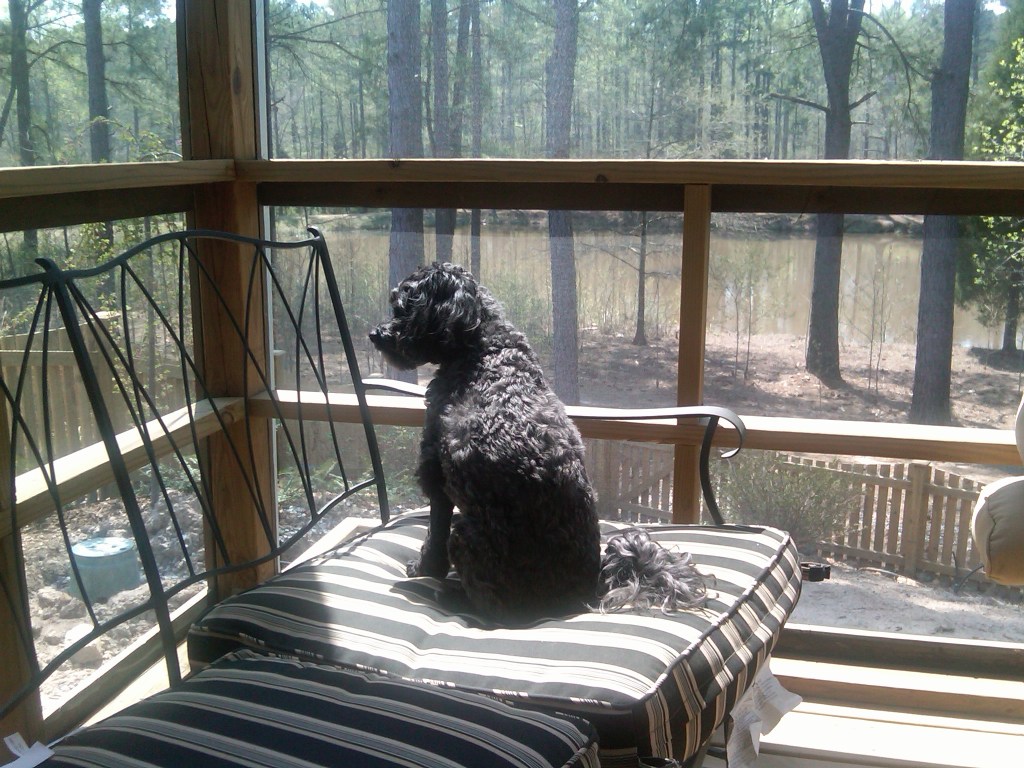
My companion on much of this 20-year medical journey and, at times, outright suffering is my #2 dog, Clover. She is 14, completely blind, happy and independent as the day we met. My little nurse, the only dog I ever chose, she attended my bedside for six years of intense neuralgic pain as I navigated a disease so painful it’s called the suicide disease. On countless nights, the sensitive pup lay close to me, trembling, at times even hiding, because she sensed the all-encompassing pain. Yet she stuck it out with me night after night in spite of her own fear, waiting for the stabbing pain to ease. Often my only escape was to gently press my burning face against her black soft curls and wait for the sweet relief of sleep.
My baby is now herself in the November of living. Two tired kidneys, failed eyes and a pair of useless knees slow her gait, though she still wags with each step.
The day is 12/13/14, and Clover awaits the call for her last long walk.
I find myself continually self-correcting, pulling my thoughts, hopes and fears back from the future direction we face together. The miracle is the breath itself. It is a miracle right now that I breathe and swallow without choking, that my voice is intact and my lungs open. My head travels 100 miles an hour toward the question of the medicine, the hope for which I wait. The sacred moment, however, is now. Each breath is a miracle and a gift.
The same is true of Clover – Miss Jean Louise Scout Finch, Miss Baby, Beans, little nugget of love. It’s easy to become obsessed with her kidney values, her age and even her courage in facing the world without sight and with muted hearing. The miracle of Clover is not the reach back to the gift of each night’s sleep she gave me during impossible pain, nor is it a prognosticating look forward to how many weeks or months might remain for her. The miracle of my lifetime baby is the breaths she takes right now, once again dutifully by my side, fully aware of and at peace with what is happening inside us both.
I want to press pause and hold this moment forever. That, of course, means I miss the next miracle, and the next, clinging in fear to hold on to something that has already passed.
Pause, at least in this moment, is a more helpful verb than wait.
We wait for this and that or the other. In pausing, we simply stop without any implied or implicit action or future hope. The pause simply is. And in each one lies a miracle if we but tune our attention to hear the symphony that surrounds us.
Two decades ago when I first struggled to understand an illness taking over my being, I encountered Buddhist monk and Zen Master Thich Nhat Hanh. This excerpt from his work, The Miracle of Mindfulness, was shared with me by a mentor and coworker weeks before his own death. It was two decades before I came to understand it in any real way.
“I like to walk alone on country paths, rice plants and wild grasses on both sides, putting each foot down on the earth in mindfulness, knowing that I walk on the wondrous earth. In such moments, existence is a miraculous and mysterious reality.
People usually consider walking on water or in thin air a miracle. But I think the real miracle is not to walk either on water or in thin air, but to walk on earth. Every day we are engaged in a miracle which we don’t even recognize: a blue sky, white clouds, green leaves, the black, curious eyes of a child – our own two eyes. All is a miracle.”
The teacher Thich Nhat Hanh, Thay, now lies in extended suspended animation in a French hospital where he has been in a coma since a severe brain hemorrhage November 11.
Just today Thay’s monastic community, Plum Village, issued an update.
Thay continues to surprise the doctors with his strong vital signs and steady, peaceful breathing. They are still amazed that Thay has been able to survive and even to show small signs of progress.
A few days ago, one of the doctors shared that “Thay is an enigma”, and another said they were “witnessing a miracle.” When a top neurosurgeon from the US visited last week, he was deeply impressed by the medical team’s commitment to giving Thay every possible chance of recovery.
In recent days Thay has been showing some indications of wakefulness, but he continues to remain in a deep coma. There have been times when Thay had his eyes open for more than two hours, and is responsive, but he is not yet showing clear signs of communication. The doctors remind us that it may be weeks or months before we can understand the damage caused by the hemorrhage and discover the extent of healing that may be possible.
The medical team has started to stimulate Thay to have more wakefulness.
The update closes with an invitation.
During the holiday season, please take some time off to take care of yourself, your loved ones, and friends. Find time to be with nature, to enjoy the stars, and the white clouds and to truly come home and be at home within ourselves, as Thay always encourages us to do. You may like to write love letters instead of spending money and consuming more. The New Year is a wonderful opportunity to begin anew with ourselves and let go of resentments and regret.
The beloved teacher of millions defies all odds by remaining present in each moment, albeit below the surface much of the time, each breath a feat thought nearly impossible for someone who has sustained such serious brain injury. Students across the globe breathe with Thay, each sympathetic breath offered without intent to change the outcome. With Thay, they simply accept what is right now, with gratitude and awareness of the awesomeness of life, the sacredness of death.
The day is 12/13/14. The teacher yet teaches.
A reach to a Zen teacher seems an odd tie to the Advent message. In other ways it makes perfect sense. The Christian contemplatives, the mystics, taught and teach Thay’s same message wrapped in slightly different gift wrap.
Consider that pepper is a spice that changes the flavor of food. Salt, on the other hand, is an element that enhances flavor, making more of the same experience and substance. Contemplation, mindfulness and life’s pauses are salt to our faith, whatever recipe constitutes our divine.
A trap for so many of us is stepping outside of our noise only during times of crisis – as we wait for a diagnosis, for healing, for the passing of a faithful friend. It takes the big stuff to get our attention. We stumble into wake-up calls instead of simply awakening.
The coming week brings new milestones for me as a favorite relative awaits a big diagnosis and a dear teacher from my small Lutheran school journeys toward his final breath in a hospice facility in Hickory.
What we miss in looking only at such big things philosophically or theologically is that each moment is a miracle, an equally valuable reflection of the sacred that permeates all being.
May we sit more often in the spirit of Thay and other great teachers to experience each singularly significant miracle, the gift that awaits if we but engage in each precious moment – a sound, a smell, the unfathomable miracle of the human brain, the structure of a single leaf or a blade of grass, the warmth of a glowing fireplace.
May we, like Thay, have more moments of wakefulness. May we pause, listen and hear the eternal message.
It is 12/13/14 at 10:58 p.m. We breathe. This moment is the miracle.
All is a miracle.
© Mitzi Viola, 12/13/14


 Lost Corner Letters
Leave a reply to Heidi Jo Cancel reply