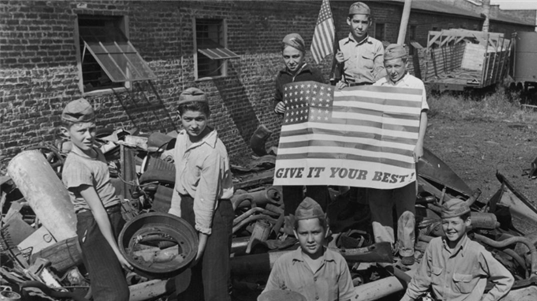
When my father was young, he and his kid brother donated their tricycle for the war effort. Patriots young and old lined the sepia-toned streets of their hometown to give household metals for reuse.
Dad was a dark-haired, dark-eyed Italian beauty with the tell-tale lips of the Irish Grady clan. Uncle Mike was less secure in the world, willing to follow his big “Bubba” anywhere, including to town on this day, along with their mill-worker father.
As the well-worn trike was handed over to the communal collection mound in the shadow of Old Glory, the working-class boys saluted.
Dad didn’t talk about it often, but when he did, he laughed at their innocence in believing their tricycle would make the difference in defending our country against the evils of the world. The glimmer in his adult Italian eyes showed a hint of hope that maybe their sacrifice had mattered.
That’s what we all want, isn’t it – to be part of something larger, something that matters, an effort that makes a difference?
~~~
I thought of Dad and Uncle Mike after seeing a Facebook post last month. Someone shared how we can support our front-line health-care soldiers in our present-day war. Someone else blamed it on Trump. Another person took offense. The post and angry comments were deleted.
Even in 1942, as the Viola boys gifted their tricycle to their country, they acted for something, without blaming or naming that which they were against. Put differently, they didn’t show up in town to trash their enemies. Sure there was plenty of that back then – and internment camps to prove it. But this day, they and other patriots of all heights and ages showed up to join a positive and unifying force.
It’s a question in our current viral and political conflicts if Americans remember such times. Ours is a different world than that of long-ago small-town NC.
The common good, perhaps, is no longer common.
~~~
My own words make me flinch. For 30 years I’ve done nonprofit work – most in the poorly paid, highly committed trenches. Like my army of comrades, this is my chosen field specifically because I believe what we do counts, that in the darkest of times the common good continues, and even thrives. We trust the power of love to win the day. Teams of riders give their time and strong bodies to fund research for people losing the ability to walk. Strangers swing hammers to make possible the security and life-changing dignity of home. Kind hands prepare meals and serve up hope for families whose children face life-threatening illness and injury.
The rising tide raises all ships, including those built from smelted tricycles of earnest Irish-Italian boys.
~~~
Last week a wasp appeared between my great-room window and its outer screen. Serves it right, I thought. Without an EpiPen in my current hunkered-down state, I’m not getting near that thing. You got yourself in there; you can get yourself out.
As I directed bad energy toward the hostile captive, my dogs whined to go out.
I shooed them onto the back porch, and a bumble bee caught my eye. They sometimes get stuck there. The porch’s outer door is left open for the dogs to come and go, sometimes capturing winged things that start with B: butterfly, bird, bee, big ‘ol dragonfly. There’s a fishing net on the porch for this very situation. With some patience and a careful swoosh of the net, most any creature can be freed with minimal harm and fuss.
On this day, the bee captive was in trouble. Damp early-spring weather had it moving slowly, like a tiny dinosaur whose gas tank was on E. Precious energy used trying to escape left it clinging to the screen with all that remained of its former bee might. “Hold on girls,” I told the dogs. “We have to help her.”
Aware of Bee’s fragile state, I whispered as I gently loosened her grasp on the screen. Soon my friend clung to my finger, and I moved her to a potting table on the porch, where I poured up a puddle of hummingbird nectar and balanced her on the edge of the lid containing the life-giving liquid. She’ll either be drowned in this or saved, I thought as she tumbled forward and flipped into the sticky liquid.
After helping her right herself, I watched as the once-lumbering insect giant created a low humming sound with the rapid movement of her sticky wings. As she buzzed, she rested on the edge of the glass feeding trough and refilled her energy tank. When some time passed, I moved the newly awakened friend to a weeping cherry tree off the porch where many such bees bumble on the border of a line of wildflowers down the hill to the pond. Soft rain rinsed her sugar-coated wings as she made her new perch a clump of cherry blossoms surrounded by damp, new green leaves.
~~~
The next morning of quarantine found me watching the trapped wasp still fighting to escape its prison cell between glass and window screen. How did you get in there? Why can’t you get out?
My thoughts drifted back to the bumble bee. Was she still there in her new, protected spot? Did she find her way home? Will I find her stiff body on the ground beneath the weeping tree?
Just then a text rang in from my neighbor.
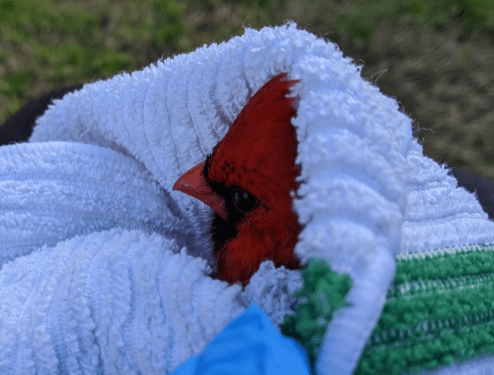
“Are you busy? Think you might be able to help me for a few minutes?” A photo followed.
“Goodness. Be right out,” I replied.
Elisa sat beyond our shared picket fence with a young cardinal resting on her lap. She found him in her driveway. A call to a rescue group led to the theory the bird was stunned from hitting her parked car. She was told to put him in a box in a dark, quiet place inside her house so he could rest. “Be sure to put holes in the box,” they told her.
“Can you help?” she asked?
“You bet!” I said. “Just a minute!”
In mere seconds I stood amid a stock of soon-to-be recycling looking for just the right cardboard respite home for a youngster with a traumatic bird-brain injury. “This! This should do,” I told the dogs.
I reappeared out back with a cozy white box filled with crumpled paper towels and a small container of bird seed, just the right mix for a cardinal. With scissors in hand, I stabbed the cardboard to complete the holes the patient would need for ventilation.
“How many air holes does a bird need?” I asked. My neighbor shrugged.
She carefully placed her charge in his recovery room and closed the box flaps to give him a safe space for healing. Then she disappeared to find a dark spot in her home that was also safe from her cat. The bird would rest until dusk. She had been told to open the box outdoors just before sunset. If the patient didn’t fly, she should take the box inside and try again in the morning.
That evening, I received a text. “He flew! Just opened the box and he took right off. <3”
Soon after, my green bird-seed container was returned, this time filled with homemade cookies. I sent a text of thanks for my neighbor’s thoughtfulness.
“You’re very welcome. I appreciated your help very much,” Elisa replied.
When I returned to the den, I pushed aside my writing desk and opened the window to free the damned wasp. “If you kill me,” I told the still lively insect, “I’ll kill you back before I go.”
~~~
What the universe reminds me, over and over, is the extraordinary weight of our interdependence.
It’s the kind of lesson we too often miss in our non-crisis lives. We have noise, distractions, and millions of thoughts that lead us away from pesky feelings buried inside our beings. Deep in our souls there’s a humming discomfort we don’t even hear because it’s winged buzzing is so deeply practiced. It takes the shock of universally-imposed isolation to call it to our attention. Silence screams.
By definition, interdependence is two-way. More than that, it’s circular and multi-faceted.
The word implies symphony, a shared reach toward completion. There’s a Zulu greeting that gets at it: sawubona, followed by its answer, ngikhona. I see you, I say as I bow to the stranger on the road. I am here, she replies. The exchange reflects the most basic human truth that we necessarily live in relationship. In real ways, we bring each other into existence through the simple act of truly seeing and acknowledging another human soul.
It’s a known fact that I’m called to free bees and other critters caught on my screened back porch. It’s romantic and surely deceiving to see only the good I give in helping a friend nurture a young bird back to flight.
It’s harder, and more fully honest, to admit that in my backed-in-a-corner existence of several weeks alone in my house, I, too, have needs. I’m scared to go to the store with a half-working immune system. Still there are supplies to get for the dogs and me, those not on Amazon. I worry about my sisters and their husbands and so many people who are no longer working. My once-craved and measured distance from people is now a growing burden.
Still, the solitude is not all bad.
In my time at home for the common good with my buzzing brain turned down, I’ve heard and seen clear messages I might have otherwise missed. Among the truths I’ve received is the solid knowing it really is going to be okay. While what’s happening is hard – and surely more difficult for some than others – I feel I already know the big-picture outcome. That’s not to say we won’t all suffer to varying degrees. Many lives will be lost. That’s the way of living, and this is ‘real life’ if nothing else.
Silence has also amplified the online sharing of friends I would have missed had I been running to and fro in my usual day-to-day help-full-y distracted way.
“Just wanted friends to know that I had a mini stroke this past weekend and am in the hospital. I’m asking for your prayers and positive thoughts.”
“Friends, my wonderful brother [suddenly] passed away earlier this week from cancer. Our hearts are shattered.”
“And just like that I’m furloughed.”
These statements are the words of long-time friends I deeply love.
My heart is broken open with empathy. It’s because I, too, have suffered that I can put myself in that place, that terrible, helpless emptiness in which they now reside. In the collective newness of 2020, we all find the equalizing gift of loss of control.
At least once a day my mind drifts into worry about how much money I can donate – either directly to friends or to nonprofits. Will those donations take my own tank too close to empty? There’s a stimulus check coming. I have a constant pile of medical bills with payment plans, prescription drugs and co-pays, but some people have nothing today. I can skip a thing or two and share. There are tangible things I no longer need I can put straight into someone’s hands. I do this on a regular basis. Last year I found myself with only two towels, four pillows, and two blankets in the house because someone down the road, not far from here, doesn’t have anything and, you know, it’s cold outside.
As my empathic fear rises, the buzzing in my head drowns out my awareness of my own breathing as I’m sucked farther into fearful darkness.
It takes a crisis like a global pandemic to remind us for the umpteenth time that we are all intrinsically broken, scarred and in need, in the same or similar ways. Our constant running keeps us unaware of our own psychic pain, which we’re required to re-experience in our new and mostly unwelcomed lack of movement.
It’s deceiving to believe I’m generous or helpful. It’s another humbling thing to admit that it’s my own fear of not having someone there for support that drives my buzzing need to help someone else, one might say everyone else. It’s yet another level of humility or humiliation to remember that my longing to assist comes from my own life experience of real helplessness at times. I fear there being no one to help life’s innocent, lost creatures because I have been that same bird, butterfly or bee – in real and heavy ways.
Interdependence is not sparked by seeing another in need. It isn’t the result of seeing for the first time the value of people whose jobs are “essential,” nor does it come from hearing the pain and standing witness to the suffering of another who had a stroke, or suddenly lost a sibling or a job amid circumstances too large and powerful to change.
Interdependence is formed by the realization that she who suffers is I. Although I’m still working, I am also he sitting at home worrying about the mortgage. Although I don’t have kids, I’m the single mom without a clue how she’ll feed her children this weekend as the rising tide of fear looms.
Interdependence is the acknowledgment that when one suffers, all suffer. This lesson comes only from pain – when the only way out of hard times is through. Interdependence is defined in part by realizing once and for all that the fuzzy, buzzing bumble bee and the menacing, dangerous wasp are the same creature, both trapped behind nearly invisible screens they can’t escape without the help of someone with a different perspective or better tools.
Question: What is it that leads me to lovingly save one while ignoring the slow death of the other?
Answer: Only one of them is dangerous. As defined by me in the moment.
We are each at times in our lives the harmless, bumbling and grateful bee. Likewise, we’re also destined to play the part of the foil character from time to time. These cats are dangerous and scary – I’m not like that, that’s not me!
And because we’re uncomfortable with this truth, we project our stinging self-judgment onto a tiny, dispensable insect that’s just trying to get home.
~~~
I long for a sepia-toned world in which the common good is our default. I wish to reach back to a time when naïve children give the tricycle they treasure for the benefit of (all) the community. I ache for a world in which we see (all) the others of the earth as ours, even those who scare us because we don’t have experience with them and therefore don’t fully understand their means and motives. I belong to you, and you belong to me. Sawubona. Ngikhona. I see you. I am here.
We are being pushed through a collective colander that scrapes the hides of everyone. This is a place of universal discernment, a cosmic purge. We are called to attention as a global family. There are certainly people suffering more than others. This must be repeated. We are all in the same storm, but we are not in the same boat. Having time, freedom from real fear, and a home in which to sit and write with a view of lush spring green within earshot of an evening symphony of frogs and crickets makes me more privileged than most in this world. It’s my obligation to continually revisit this truth.
This crisis is a rare opportunity (yes, opportunity) to be forced by anti-movement into recognition of things we buzz and buzz to reject – the things we fear most and sublimate. They are teachable couplets.
There’s nothing wrong with me (or you); there never was.
We’re all the same; I’m not special.
I’m not worthy of my lot in life; nor are you of yours.
I can’t judge how you came to be where you are; it isn’t anyone’s job to judge.
Our job at this time, simply put, is to love. For me love requires action. So love transferred to action is all we’re each called to do – at all times, and especially right now.
You don’t have to follow this home-school lesson, but there’s a greater than average chance you won’t be promoted to the next grade if you choose to reject the teaching, this universal truth.
~~~
As the COVID-19 crisis warmed to a boiling point, I was wrapping up three weeks of vacation. My treasured time alone for rest and reflection lay in the shadow of viral predictions. I’m a planner with medical issues. My dogs are 11 and 15 and have their own prescribed meds and food. And to top it off, I take immunosuppressive drugs, making shopping more risky each day the virus spreads.
Three decades of nonprofit disaster planning kicked into gear. There were lists of lists – things to purchase online and in stores, the sooner the better. “Things to do” filled another paper. Notes on the money lay neatly placed on the ottoman just feet from a soon-to-be trapped and menacing wasp. Top of mind for me was how to get 90 days of precious hydroxychloroquine approved by my insurance. A brief bottom-page mention of its use to treat the virus in China crossed my phone. Before it was widely touted as a possible coronavirus fix, I was already running into resistance having my prescription extended to three months. American doctors who heard the same anecdotal reports wrote precious prescriptions for themselves along with their families and friends, papers worth their weight in gold for people who need the drug daily to just keep going.
Like those who are privileged with the luxuries of medical insurance, vacation, and debit cards, I began putting into place everything I would need to stay home for up to three months. A work friend delivered my computer, and I was soon set up for whatever lay ahead.
Planning for life’s worst creates a natural, singular, and inward focus. I took care of myself and my sisters first, then friends. Trips to the store were increasingly dissatisfying as my fellow Southerners and I gave less energy to eye contact and cordial greetings, focusing instead on the most efficient route to tackle our lists.
Supplies ran low. Big-city, depersonalized silence crept into our town as we shopped and planned in numb pragmatism and thinly-veiled fear.
By the time we were shut in for the unknown duration, most of us were a mix of emotionally numb and surprisingly anxious.
~~~
If patriotism and the common good are soft sepia-toned images with scalloped, worn edges, the first days of the COVID-19 emergency were strung-together flashes of stark black-and-white photos that dropped like bombs across our televisions and our phones. Fever. Cough. Masks. Pneumonia. ICU. Ventilators. Coma. Death. Front lines. Supply chain. Casualties mounting.
Alternating media footage of vacant city streets and informative charts showing community spread and always rising diagnosis and deaths rates rang loudly like old war movies, only without any nostalgia whatsoever.
The pall of death cast a shadow across our great land, our homes, and our hearts as we hunkered down for the final body count.
How many months will it last?
How many I know will die?
Might I?
~~~
Crises and challenges reveal who we are. Once shock and adrenaline wear off, these experiences serve as magnifying glass to our souls. Crisis is a pop quiz in a world where every action is indeed a test. Because we people are able to be both loving and fearful, the hallmark of the human condition, our actions in crisis reflect the same continuum. Each moment offers a new choice.
In small flickers of light, our COVID clouds began shifting just enough to assure us there is still a sun at work in the world, even if she is a bit shy these days.
In my hometown an older woman in a downtown neighborhood began feeding 100 hungry people each day. She collects food and any cash neighbors can spare and carefully stewards each gift to feed as many people as possible, without question or qualification. She asks nothing in return. With each rising of the sun, the giving begins anew.
Durham schools didn’t skip a beat in the teamwork it takes to feed children who are hungry when school is closed. There was never a question of the importance of the mission or the certainty it would happen. Employees, many at risk themselves, gladly cooked and packed simple meals, presenting them with love to children and their entire families. When staff became sick and the program closed, the community stepped in.
People are not forgotten here. This town remembers, and we act.
The old-fashioned image of young boys giving their tricycle for defense of their country has nothing on Durham, NC, USA.
Here the images are bright, full-color, creatively cropped photos and community murals. They show grit turned to grace and mercy. We color in a hundred hues in varying shades on proud, simple matte paper, each work a humble and respected masterpiece.
Across America, the same spirit births ten thousand spontaneous rescue operations to reach neighbors in the nick of time. Friends and strangers show up in creative and selfless ways. We support and cheer medical heroes, prop up our suddenly jobless neighbors, and smile with our eyes above homemade masks in agreeable nods to allow the person with more need to move ahead of us in the grocery line. We might even pay for her haul.
If Italy and Spain are uniquely qualified to unite country in song, America runs a first-class rescue relay without question we’ll cross the finish line as a team. We’ve got this.
Americans predictably and selflessly rise to the occasion. 9/11, Oklahoma City, Katrina. These simple words still draw us to that proud, teary-eyed place where we remember our innate interdependence. Sawubona. Ngikhona. I see you. I am here.
~~~
While spontaneous, generous spirit is our hallmark trait in crisis, our greatest deficit is our ability to forget the intrinsic personal responsibility of mutual belonging in the good times.
Sure, there are always givers and kind hearts. They operate quietly in the background of daily life. I’m beyond lucky to see them through my job every day. But generally, it takes a large-scale tragedy to shake us off the political continuum or principled high places and recruit us to the same unified team.
We must be brought low, trapped en masse behind screened porches with precious energy waning, to revisit the physiological realities of trauma that forever brand our psyches. Our constant buzzing and noisy minds must be silenced in order to sit still and simply feel. There are pesky feelings we’ve ignored, and now we’re at home with time on our hands for the experience. Even if we’re blessed to be working, the possibility of global economic depression, the worst ever known, is fuel for nightmares and open wondering. We’re stuck in a storm we can’t predict or truly influence. We don’t know how things will turn out. We can’t know.
Then and only then are we broken open to receive grace. Our brilliant brains, our professional successes, our financial pride, and our sparkling good looks are all shaken loose. When the temple of vanity falls, our squishy, vulnerable insides are laid bare for all to see. Without distractions, we are left to sit alone with our true selves.
In these times, these dark nights of the soul, the modest seed of empathy is watered. Suddenly I relate to nearly everyone in this country. Your trials and my trials are similar. Though we’re on different ships, we are indeed in the same storm. I am yours; you are mine. Perhaps for the first time, I see you without snap judgments or assumptions. The pointless labels of wasp and bee fall away. We are, after all, vespid family.
The most dangerous thing we can do now is forget how the vulnerable space of interdependence feels.
American independence is our hallmark trait. It is also our Achilles heel. We were born to win, made to succeed. Our bootstraps are worn from years of rugged toil. We’re the givers, the world’s reliable big brother. We lead, and they follow.
While there have been skirmishes, global wars do not level our churches, synagogues and mosques. Our iconic cities are not laid bare amid the burning, defeated stench of war. Foreign powers do not occupy our soil. That simply doesn’t happen here. The result is that our national identity (different from our personal identities) is devoid of the psychological trauma of real and present danger. This is a rare privilege.
Our country’s position as a near island between two oceans sets us apart in precious and precarious ways. We forget to count our blessings, seeing them instead as normal, and those who lack them as deficient or lacking.
I love this country. I’m a proud American. And when you truly love a thing, you’re in a unique position to hold it accountable to higher truth. What’s happening to us in this crisis right now – on your street and in every zip code in your town – is the kind of leveling through suffering that unfolds across the world every single day. Most nations and peoples do not enter the storm with anything close to the safe vessels many (but not all) here take for granted. We forget this again and again.
I don’t think our amnesia is real. Put differently, I don’t believe we actually forget the fact of our abundance. I believe the problem is deeper and more dangerous. We have internalized the fiction of our unique global worthiness. We don’t question how we came to be born into this culture and economy, or what responsibility we hold for our position. We deserve it. And the necessary corollary is they deserve their lot in life, too. We’re aren’t the same.
Psychology tells us that when can’t relate to people having a difficult experience, it can be hard to hold empathy. When we don’t have empathy, we don’t care. It’s not that we sit down one day and decide to not care about other humans. Instead, we fail to see people straight on. This is what we casually call looking the other way. We don’t wish others harm as much as we choose not to see them. It’s as though they are invisible.
We don’t think openly in cold thoughts or harsh judgments. Our unspoken American belief system contains tiny particles of our national DNA that are as easily absorbed into our very beings as the virus from which we now seek refuge – because this one, COVID-19, is alas a direct danger to you and to me.
Nations of privilege can set aside the people and situations that make them feel uncomfortable because they have the luxury of doing so. They are unique in this way, and America is in the lead position.
We say things like, “It’s sad what’s happening to the children on the southern border. Their parents should be ashamed for putting them in danger.” Their parents, after all, are wasps to be blamed. We can say these things because we don’t get close enough to know any of them personally. They’re different than we are. They got themselves in there; they can get themselves out.
“Our native people suffer, but look at them. They’re unemployed alcoholics. Why should my hard-earned money support people who won’t help themselves?” They got themselves where they are; they can get themselves out.
Let’s not even talk about the man begging for change on the corner. He’s drinking it all up anyway. He put himself on that corner. You know the rest.
~~~
There are two places we’re told not to ‘go’ in polite company: politics and religion. I’ll start with religion.
If you’re feeling defensive, especially if you’re Christian, tell me what you’re doing to soften the hard edges of our world – close to home or far away. Don’t tell me what you believe; show me your sermon. Isn’t that, after all, the person of Jesus? It’s not all text, doctrine, and dogma. The whole story is a call to action, an example by which we are challenged to shape our lives with every move, however modest or grand. Christianity at its best is a living example of community and interdependence in which we’re always responsible to and for the other.
The Gospel is by definition political. The focus on the least of these is and was a charge to choose time and again the way of love instead of the way of power and domination. Jesus’ whole shtick was to hang with those who were low, abandoned, judged. He didn’t take notes on individual worthiness or acceptable levels of personal responsibility. That’s precisely not the point. Here’s the point: love anyway.
~~~
Our current political world is equally dialectically charged.
One side leans more heavily toward empathy and communal responsibility, and the other more toward liberty and personal responsibility, as though the two positions are mutually exclusive. The two ways are necessarily always allowable and true at once. We don’t have to choose.
Further, we’ve cartoon-ized the teams as “snowflakes” and “haters,” as though our multi-faceted, colorful world is a simple black-and-white silent film of old. This steals the identity of every individual along the continuum, including you and me. Very few people lean so far in one direction that we’re truly politically extreme. The normal curve tell us nearly 96 percent of life falls within two standard deviations of the norm. In other words, nearly all of life is a similar shade of gray. And yet most of us have in just the past week generalized in broad brush strokes with such words as “liberals” and “the Republicans” as though they are all the same evil creature.
~~~
If we put politics aside, the only question that remains is how you and I each choose to be responsible to one another as citizens and fellow human inhabitants of our planet. You see, the fight over the government’s role in our socio-economic world is irrelevant when considering my own individual responsibility for my neighbor.
Drop the political argument, and go do something good. Start an open conversation. Listen. Seek first to understand. You don’t have to save the world – just cease thinking and talking and do one little thing. Pick up the tab for the family behind you in line for take-out. Leave the last pack of toilet paper if you don’t really need it. Let November settle the government question. Whatever you define as “the problem” our country faces right now, each of us has a responsibility to actively right what we see as wrong. Go do it.
There is a world of hurt out there, much of it well within our literal and virtual reach.
- If every person living in Lubbock, TX, were killed by insidious assassins, that would equal the number of innocent people murdered because they live in the crossfire of Syria’s civil war. That’s about 250,000 tragic civilian deaths. To simplify, an extreme rebel group formed in response to a perceived extreme government. The unfortunate luck of living in a town sought by extremists to solidify their power means for many millions literally running away from their homes and everything they’ve known with only their children and what little they can carry. If they don’t flee, they face almost certain torture, rape, and death. Because we cannot relate, the news reports fall short of reaching willing and open ears. Worse, because the majority are Muslim, we fear those who flee are terrorists. This is somewhat like denying persecuted Christians shelter for fear the KKK will sneak in amid the group. Give that some thought. Untold millions of innocent people – parents and grandparents like you and me – suffer as their children grow up numb to the barrage of bombs and the constant running for one’s life, the squalid refugee camps they did not a single thing to deserve. These children will never heal. Denying them aid only increases the chances they will grow up to join the resistance. To us they are potentially dangerous wasps in the making, so we hold them away rather than help. We don’t even see them.
- Closer to home, Americans living in Flint still lack safe water. Children poisoned by lead won’t heal. Cognition doesn’t return when the water is fixed – if it’s ever fixed. This is happening in the so-called greatest nation on earth. Yet we can’t relate to their plight, so the news reports fall short of reaching willing and open ears. We become numb to the meaning of the words. What’s worse is the tragedy falls largely on racial and economic lines, an inconvenient truth we’d rather not acknowledge. Because of our relative privilege, we debate the issue and the government’s role philosophically – because we have the luxury to do so from our comfy chairs and high moral positions. I care, but it’s not my problem. What am I supposed to do?
- The world food crisis is the so-called third wave of COVID-19 destruction, following our initial wave of disease and the projected second spike. An estimated 500 million souls will fall newly into poverty because of the pandemic. As a point of reference, there are about 350 million people in this country. This doesn’t take into account the 3 billion already living in extreme poverty. Millions, many women and children, face death from starvation. Their demise will be slower and more painful than the wasp I was willing to let die because of its inconvenient position in my window to the world. The group expected to suffer most in secondary consequence to the virus: girls. And some of them are our neighbors right here.
~~~
And who is my neighbor?
It’s a lingering question. I’m not sure there’s a correct answer; we’re all where we are with the thought at any point in time. But it’s a subject worth revisiting every so often – say, once or twice a month, when you and I get paid. When was the last time you struggled with the decision of whom to help with your limited funds? I don’t sweat that decision often, but I did last week with this inconvenient and greedy virus moving in. The exercise clarified for me my values and priorities. And it was just that – an exercise, a blessing for which I’m thankful every day.
We can’t do everything. No one can, and that’s not the point. It also doesn’t mean we’re off the hook to act as our brothers and sisters suffer. Our prayers alone are not enough.
What do you expect me to do – give away all my money? Choose asceticism and a life without pillows and towels over real life? We can’t let everyone in this country. Am I supposed to feel guilty for being born here?
Of course not.
What if we did just a few things differently?
- Make a practice of remembering a time you suffered or felt helpless, whether it’s from the coronavirus or something else.
- Remember and give thanks for a person who helped you along the way.
- Joyfully seek an opportunity to be a light for someone once a week or once a month – whatever rings most true to you. Stay anonymous if you like, and seek relationship when you can.
- Consider what noise or buzzing in your pre-COVID world you can leave behind as we walk forward together into our new way of being.
- Expand your world. Seek out conversation with someone who doesn’t share your views. Listen more. Talk less. Seek understanding rather than being right.
- Do your best, and try again when you fail. Offer grace to yourself and others, and you will receive it in turn.
- When in doubt, the answer is love.
If this essay sparks one conversation that leads to one reconciliation, one discovery of shared humanity and mutuality, so be it. That one connection will make the writing more than worth the time.
We are better people when we remember our sameness. We are better people when we remember our own times of weakness, defeat, and uncertainty. This current humbling of our nation is a reset we didn’t expect. Someone unplugged our computer system without our permission, and we must wait the requisite 20 seconds, or 2 years, before we reboot. We will all lose and grieve in real ways.
The crisis is indeed a gift, a chance to be tamed by anti-movement into recognition of things we would rather deny. Give thanks for it!
Resist the personal and collective amnesia that allows us to separate from our shared journey as humans living on this earth, today in the year 2020. Resist letting this crisis become a thing you lived through rather than a thing that changed you.
Our job right now is to love – ourselves and every other human doing their very best to check another day off the calendar. What if that’s our only job until we have a coronavirus vaccine? What if we humbly start each day with the intent to show love?
They say takes just three weeks of action for a new habit to form.
Don’t do it for the sake of “needy” people. Do it because you are more fully human, more alive, and more divine when you live in love. Do it because you, too, have needs.
I heard it said on television recently that this ‘golden moment’ should not be wasted.
Remember this time we’re in when Ebola arises again across the globe and distant neighbors suffer and die in hemorhaggic fear.
Remember when people seek refuge and citizenship here because it’s less scary to face a perilous and unknown journey than to stay in place and face certain suffering.
Remember when unemployment benefits are on the line that maybe, just maybe, one’s story isn’t what you think.
Remember that an idyllic sepia-toned world never did exist. Ask any person of color in rural Southern 1942 or today, or women of any race or creed.
Remember the next time you see a young mother or someone’s grandfather struggle to count out the change to pay the grocery bill. Pay it for them, and give thanks that you can. Someone helped you once, you know.
I am yours; you are mine. When one hurts, we all suffer. Your pain is mine, and mine is yours. Our interdependence and mutuality require that we bring one another into existence, again and again.
Sawubona. Ngikhona. I see you. I am here.
May we rest and rise in full color into this remembrance.
© Mitzi Viola 5/3/20


 Lost Corner Letters
Leave a reply to Heidi Sommers Cancel reply